
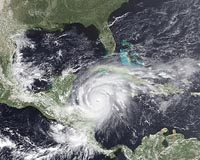
An above-normal hurricane season in the Atlantic Ocean could be problematic for the U.S. energy industry, but data show shifting production patterns may spare oil.
Meteorologists with the National Oceanic and Atmospheric Administration's Climate Prediction Center said this year's hurricane season in the Atlantic, which extends from June 1 through Nov. 30, is more than likely to be active. There's only a 20 percent change for a below-normal hurricane season and a 70 percent chance of at least two major hurricanes, classified as a Category 3 storm with winds stronger than 110 miles per hour.
"Regardless of how many storms develop this year, it only takes one to disrupt our lives," Robert J. Fenton, Jr., the acting head of the Federal Emergency Management Agency, said in a statement.
An average hurricane season produces 12 named storms and as many as 17 are expected this year.
Hurricane Matthew was a Category 3 storm when it hit the east coast of Florida in early October. The U.S. Energy Information Administration estimated about 2.5 million residential, commercial, and industrial electricity customers lost power across five states because of Matthew.
Motor club AAA reported that Matthew forced the closure of fuel terminals in Florida, Georgia and South Carolina. Most of the coastal ports reopened in the region by the time remnants of Matthew moved out to sea, but the storm caused short-term gasoline shortages and skewed the national average price at the pump higher.
This year's season got off to an early start when Arlene became only the second such tropical storm observed in April in the Atlantic Ocean. Forecasters for the U.S. National Hurricane Center said that detecting a storm as weak as Arlene was "practically impossible" before the modern weather-satellite era, however.
A report from the Energy Information Administration in 2013, a below-average year for the Atlantic hurricane season, found the disruption to regional oil and gas production had declined because of the shift inland for production centers. The latest monthly report from the EIA found production of crude oil, for example, was around 9.1 million barrels per day during the first quarter, but only 1.6 million barrels per day came from the Gulf of Mexico.
Fifty years of Lagos. But what about the next 50?
The Nigerian megacity of Lagos, with its 20 million inhabitants, is the biggest in sub-Saharan Africa and is celebrating its 50th anniversary.
But how do those who have made their name in Lagos envisage the city in 50 years' time?
– Leye Adenle –
Leye Adenle was born in Nigeria in 1975. His first book, "Lagos Lady", is a gripping crime novel that flits between the city's less salub … read more
