
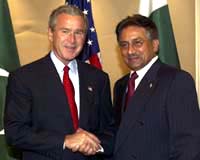
The United States on Friday urged Pakistan's military leader Pervez Musharraf to set a date both for holding elections and resigning as army chief to show he means to return to constitutional rule.
The public appeal for dates from State Department spokesman Sean McCormack signaled a tightening of US pressure on Musharraf, who sparked international outrage with his declaration of emergency rule on Saturday.
"President Musharraf should roll back the state of emergency, schedule a fixed date for elections coming up," McCormack told reporters.
"He committed to those elections no later than February 15, he also recommitted to taking off the uniform," he said.
"He should make that commitment publicly and fix a date for the Pakistani people so that they have an expectation that they are now going to return to constitutional rule and the pathway to democracy," he added.
After US President George W. Bush on Wednesday bluntly told the Pakistani leader to proceed with polls and to step down as army chief, Musharraf announced the elections would be held by February 15, without giving a date.
State television also reported that Musharraf on Thursday renewed his promise to give up his uniform before taking the oath for his second term in office, but he gave no date.
Musharraf cannot be sworn in until the Supreme Court rules on the validity of his victory in an October 6 presidential poll that gave him another five years in power.
McCormack said Musharraf, who seized power in a bloodless coup in 1999, had for years made progress on political and economic reform that had benefited Pakistanis before the state of emergency was declared.
"That's the kind of pathway Pakistan should return and the kind of pathway that is going to benefit the Pakistani people," he said.
McCormack also welcomed moves by the Musharraf government to release from house arrest the former Pakistani prime minister Benazir Bhutto.
"We understand from the government spokesman that she's going to be allowed to leave," McCormack said before her release became official.
"And as we have said for the past week, we believe it's important for those moderate forces, moderate forces within the Pakistan political system, to work together to get Pakistan back on the road to democracy and constitutional rule," he said.
"So we believe that is positive."
