
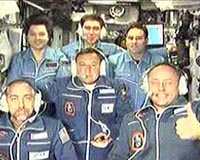
There is hope that the additional 200 billion rubles ($7.3 billion) to be allocated for the country's space industry will be used to developing a new escape system for space crews.
Though not entirely neglected, escape technology has made little progress in Russia over the years. The project might come to fruition considering Russia's plans to develop a new manned reusable space transportation system and the ongoing International Space Station.
The flight's initial stages are considered the most life-threatening for astronauts. We can still see the Space Shuttle Challenger disaster in January 1986, when the spacecraft exploded within seconds of the launch, while millions of people watched on live television. The idea of saving crew life from an explosion caused by a faulty seal in a solid rocket booster seems almost impossible.
Meanwhile, the Buran space shuttle developed during Soviet times provided life saving procedures under two scenarios.
In one scenario, in a booster fire, just prior to, or during launch initiation, the crew could exit the cockpit through a hatch, climb into a water-filled concrete trough and slide 117-meters down onto special mats with quick access to a high-heat resistant chamber. All Buran spacecraft pilots were required to rehearse using this rigorous escape system.
In the other scenario, if an emergency occurred after launch, below an altitude of 24 kilometers and below a velocity of 3,000 kilometers per hour, cosmonauts could eject themselves from the spacecraft.
Today, an efficient high-altitude astronaut escape system could provide safety for International Space Station crew members. Currently, ISS escape is provided by a docked Soyuz spacecraft offering the security of a 99-percent reliability record despite its age. Nevertheless, technical progress cannot stand still.
Even with Soyuz's efficient service, the ISS requires a more efficient escape system for a crew of at least four. To this end, NASA began work on a special crew survival spacecraft in the early 2000s, but the project was dropped during development. So far, the Soyuz spacecraft is the only vehicle or system providing a safety option for ISS crews.
The additional funds for Russia's space program could revive the development of an in-flight crew escape system for the ISS. A unique crew and equipment escape system, engineered at the Babakin Science and Research Space Center, is designed for spacecraft operating at any altitude and could be a good beginning point.
An inflatable conic parachute device, named Volan, was designed to hold a pilot or equipment in its center, thus resembling a badminton birdie. The device can land from any altitude, with any person or object safely returning to Earth.
Five years ago Russian scientists tested the system to ensure a soft landing. Further development was discontinued due to a lack of funding.
Source: RIA Novosti
Share This Article With Planet Earth
