
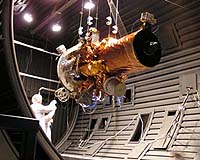
TacSat-2 launched successfully at 7 a.m. EST on Saturday, Dec. 16. TacSat-2 will be propelled into a circular orbit approximately 255 miles above the Earth by a Minotaur I launch vehicle. The satellite, housed in a shroud atop the rocket, will be released into space between 100,000 and 150,000 feet altitude, and will share the brief ride into the cosmos with NASA's GeneSat-1.
TacSat-2 features 11 onboard experiments, which will be conducted during the spacecraft's planned six to 12-month mission. The U.S. Navy's Target Indicator Experiment (TIE) consists of a wideband sensor to gather radar, radio, and handheld communication signals. The TIE will also check for the automated identification transmission now mandated for large ocean-going ships. TacSat-2 can directly talk to any common data link compatible ground station across the globe.
Other features include the integrated global positioning system occultation receiver, which will compile high-precision location data for the micro satellite, recycled solar array panels producing 500 watts of power, and autonomous operations allowing TacSat-2 to think for itself.
NASA Wallops Demonstrates Capabilities With Successful Rocket Launch
The NASA Wallops Flight Facility demonstrated its quick response capabilities with the successful launch this morning of an U.S. Air Force Minotaur 1 rocket from the east coast of Virginia. The rocket was launched at 7:00 a.m. (EST) carrying the Air Force Research Laboratory's TacSat-2 satellite and NASA's GeneSat-1 microsatellite.
"Since being selected by the Space and Missile Systems Center Space Development and Test Wing as the launch site a mere 7 months ago, Wallops personnel met all launch goals. Wallops personnel definitely have a 'can do' attitude and they did whatever was necessary to get the job done," said John Campbell, director of the Wallops Flight Facility.
"As we have been doing throughout our 61-year history, the Wallops staff responded quickly and efficiently to the country's launch needs," Campbell said. "It was truly a team effort and an honor for the Facility to work with all the participants to support this successful launch," he added.
The satellites were launched on the four-stage Minotaur I launch vehicle contracted by the Space and Missile Systems Center through Orbital Sciences Corporation's Launch Systems Group. The mission was conducted from the Mid- Atlantic Regional Spaceport's launch pad on the south end of Wallops Island.
Two Minotaur 1 rockets are scheduled for launch in 2008 from Wallops carrying the Near-Field Infrared Experiment (NFIRE) satellite in April and the TacSat-3 satellite in October. Both missions will use the Spaceport's launch pad.
