
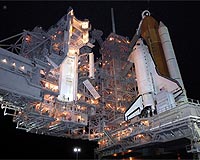
The planned launch on Thursday of the Atlantis space shuttle and its cargo of a European laboratory could be scuttled by the onset of bad weather, NASA said.
After postponement from early December due to technical problems, the flight faces new hurdles from a cold front expected to deliver clouds and rain during the 10-minute launch window on Thursday beginning at 2:45 pm (1945 GMT), said Kathy Winters, a meteorologist for the mission.
"Our primary concerns for launch day are cumulus clouds, showers, and an anvil from an inland thunderstorm," she told reporters.
The National Aeronautics and Space Administration Wednesday gave a 30 percent chance for the launch to go ahead on Thursday.
They also warned that if the storm stalls over central Florida, launch windows on Friday and Saturday could also be squelched.
The mission is to deliver the 10-ton European laboratory unit Columbus to the International Space Station, which is being developed as a jumping-off point for exploration to Mars and beyond.
With room inside for three people and operated by ground staff at a control center near Munich, Germany, Columbus will enable the European Space Agency to conduct experiments related to biotechnology, medicine, materials and liquids.
The lab cost some 1.3 billion euros (two billion dollars), paid mostly by Germany, Italy and France.
The main task for the mission is to use the ISS's robot arm to transfer Columbus out of Atlantis' payload bay and attach it to the space station.
Three spacewalks are scheduled during the mission, which is seen as a major step forward for European ambitions in space.
The Atlantis crew includes astronauts Leopold Eyharts of France and Hans Schlegel of Germany. Currently there are US and Russian astronauts at the space station.
Schlegel will conduct two spacewalks during the flight to connect power and fluid lines between Columbus and the ISS.
Eyharts will become Europe's first long-duration station resident on the space station, replacing US astronaut Dan Tani.
Atlantis was originally scheduled for blastoff on December 6 as part of the tight schedule of shuttle flights to complete the ISS construction by 2010, when the three-craft US shuttle fleet is to be retired.
But malfunctioning circuits in the fuel gauges of the spacecraft's liquid hydrogen tank forced a two-month delay.
Senior NASA official Bill Gerstenmayer has said engineers tracked down the cause of the recurrent problem and it would not re-occur.
"Atlantis is ready to go fly," Charlie Blackwell-Thompson, assistant NASA test director, told reporters Monday, when the crew arrived at the Kennedy Space Center in Cape Canaveral, Florida for the launch.
