
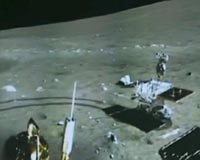
It's been a few days since China said that the embattled Yutu Moon rover had sent a transmission back to Earth. Yutu suffered a mechanical anomaly roughly four weeks ago, shortly before it entered a frigid two-week lunar night.
The anomaly, believed to involve a faulty solar panel mechanism, threatened to cause Yutu to freeze to death in the darkness. Yutu was apparently silent after daybreak, but apparently transmitted something after roughly three days.
Since then, there has been a lack of information on the state of Yutu. China is investigating the state of the rover and probably working on strategies to continue its operations.
Right now, we don't know exactly how much of the rover works, how much could work in the future, or how much has been damaged beyond use. We also don't know if anything useful can be accomplished with the rover now.
China has been stingy on releasing information, but this is understandable. The Chinese themselves are probably slowly, methodically and cautiously testing their robot. Releasing any information prematurely could lead to confusion or concern.
How can they tell the world about the state of Yutu when they are not entirely sure themselves? The Chinese were fairly open about the fact that Yutu had suffered a mechanical anomaly and was generally not expected to survive. Given enough time, we can expect more official reports.
The state of the rover itself is also probably changing. As time passes, it is steadily being heated by the sun. This will probably affect the state and the functionality of some of its parts. The angle of the sun is also changing as the sun rises.
This means that different parts are illuminated at different times. Some of the rover's most sensitive components could be warmed back to life if they are hit by direct sunlight in the next few days.
For the moment, all we can do is wait and hope for the best. It's already a good sign that a transmission was received after the long night. This alone provides useful engineering information on the state of the rover's components and their suitability for future missions.
