
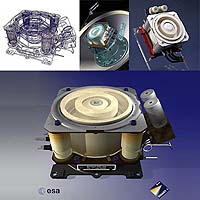
SMART-1 is packed with high-tech devices and state-of-the-art scientific instruments. Its ion engine, for instance, works by expelling a continuous beam of charged particles, or ions, which produces a thrust that drives the spacecraft forward. The energy to power the engine comes from the solar panels, hence the term 'solar electric propulsion'.
The engine generates a very gentle continuous thrust which causes the spacecraft to move relatively slowly: SMART-1 accelerates at just 0.2 millimetres per square second, a thrust equivalent to the weight of a postcard.
By necessity, SMART-1's journey to the Moon has been neither quick nor direct. This was because, for the first time, ESA wanted to test electric propulsion on a trip similar to an interplanetary journey. After launch, SMART-1 went into an elliptical orbit around the Earth. Then the spacecraft fired its ion engine, gradually expanding its elliptical orbit and spiralling out in the direction of the Moon's orbital plane.
Month after month this brought SMART-1 closer to the Moon. This spiralling journey accounted for more than 100 million kilometres, while the Moon – if you wanted to go there in a straight line – is only between 350,000 and 400,000 kilometres away from the Earth.
As SMART-1 neared its destination, it began using the gravity of the Moon to bring it into a position where it was captured by the Moon's gravitational field. This occurred in November 2004. After being captured by the Moon, in January 2005, SMART-1 started to spiral down to its final operational polar elliptical orbit with a perilune (closest point to the lunar surface) altitude of 300 km and apolune (farthest point) altitude of 3000 km to conduct its scientific exploration mission.
What was there to know that we didn't know already?
Despite the number of spacecraft that have visited the Moon, many scientific questions concerning our natural satellite remained unanswered, notably to do with the origin and evolution of the Moon, and the processes that shape rocky planetary bodies (such as tectonics, volcanism, impacts and erosion).
Thanks to SMART-1, scientists all over Europe and around the world now have the best resolution surface images ever from lunar orbit, as well as a better knowledge of the Moon's minerals. For the first time from orbit, they have detected calcium and magnesium using an X-ray instrument. They have measured compositional changes from the central peaks of craters, volcanic plains and giant impact basins. SMART-1 has also studied impact craters, volcanic features and lava tubes, and monitored the polar regions. In addition, it found an area near the north pole where the Sun always shines, even in winter.
SMART-1 has roamed over the lunar poles, enabling it to map the whole Moon, including its lesser known far side. The poles are particularly interesting to scientists because they are relatively unexplored. Moreover, some features in the polar regions have a geological history which is distinct from the more closely studied equatorial regions where all previous lunar landers have touched down so far.
With SMART-1, Europe has played an active role in the international lunar exploration programme of the future and, with the data thus gathered, is able to make a substantial contribution to that effort. SMART-1 experience and data are also assisting in preparations for future lunar missions, such as India's Chandrayaan-1, which will reuse SMART-1's infrared and X-ray spectrometers.
SMART-1 is equipped with completely new instruments, never used close to the Moon before. These include a miniature camera, and X-ray and infrared spectrometers, which are all helping to observe and study the Moon.
Its solar panels use advanced gallium-arsenide solar cells, chosen in preference to traditional silicon cells. One of the experimental instruments onboard SMART-1 is OBAN, which has been testing a new navigation system that will allow future spacecraft to navigate on their own, without the need for control from the ground.
Instruments and techniques tested in examining the Moon from SMART-1 will later help ESA's BepiColombo spacecraft to investigate the planet Mercury.
