
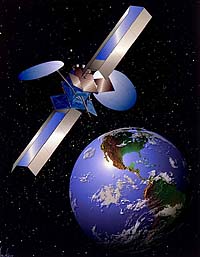
XM Satellite Radio's first satellite, "Rock," has achieved several critical performance milestones and continues easing toward its final orbital position. The company's second satellite, "Roll," is scheduled for launch May 7.
The joint announcement was made today by XM and Boeing Satellite Systems Inc. (BSS), a unit of Boeing.
"We have a bird in the air and another bird ready to fly," said XM President and CEO Hugh Panero. "XM is on schedule for its summer rollout. XM-ready radios are on retail shelves, final chipsets are with our radio manufacturers, and our broadcast studio is creating content."
"The satellite's communications antennas and solar wings have now been successfully deployed, following a successful series of five firings of the satellite's on-board liquid apogee engine," said Randy H. Brinkley, president of BSS. "The satellite's state of health continues to be excellent."
On March 18, Sea Launch successfully lifted "Rock" to geosynchronous transfer orbit from its Odyssey Launch Platform in open waters of the Pacific Ocean on the equator, at 154 degrees West Longitude. The injection orbit apogee was within 26.3 km of target and the perigee was within 22 meters of target, the most accurate injection Sea Launch's Zenit-3SL vehicle has achieved to date.
"Roll" will also launch from Sea Launch's platform on the Equator. The Sea Launch Co., an international partnership, is the world's only ocean-based commercial launch service provider. With the advantage of a launch site on the equator, the proven Zenit-3SL rocket can lift a heavier spacecraft mass or place a payload into a higher perigee, offering high performance.
Both satellites will operate in geostationary orbit above the United States. By using two powerful satellites, each with the same nationwide coverage, XM will ensure maximum signal and system reliability. All three XM satellites — "Rock," "Roll," and a spare in its final testing phase — are Boeing 702 models, the most powerful commercial satellites ever made, manufactured by BSS.
"Rock" and its twin "Roll" both have two 16.4-ft. folding deployable S-band transmit reflectors and one X-band global receive antenna. The satellites span 132.5 feet in length and 46.6 feet in width with antennas fully deployed, and have a total spacecraft power of 18 kilowatts. The satellites carry digital audio radio payloads that each feature two active transponders generating approximately 3,000 watts of radio frequency power, making these the most powerful commercial transponders ever built.
"Rock" will operate in a geostationary orbit at 115 degrees west longitude with a mass of 6,505 pounds (2,950 kg) in orbit. "Roll" will operate at 85 degrees west longitude.
XM will transform radio, an industry that has seen little technological change since FM, almost 40 years ago. XM will offer up to 100 channels of digital-quality sound and provide coast-to-coast coverage of music, news, sports, talk, comedy and children's programming. XM won several awards at the International Consumer Electronics Show in January, including "Best of CES" in the automotive category.
XM's strategic investors include America's leading car, radio and satellite TV companies — General Motors, American Honda Motor Co. Inc., Clear Channel Communications, DIRECTV and Motient Corp., the company's largest shareholder. XM has a long-term distribution agreement with General Motors to integrate XM radios into its vehicles commencing in 2001.
