
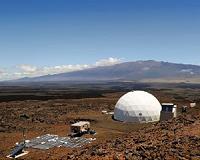
One year after living in isolation to simulate a mock mission to Mars, the six crew members emerged Sunday from their 1,200-square-foot solar-powered dome.
The three men and three women lived in the bare, rocky slopes of Mauna Loa on the island of Hawaii, as part of the NASA-funded HI-SEAS program — Hawaii Space Exploration Analogue and Simulation — in coordination with the University of Hawaii.
They exited the habitat at 9 a.m. with one crew member saying "we were hoping for some sun."
Christiane Heinicke, a German physicist and engineer, said in an interview "Right now I am super excited. It's the first time get to be outside without a space suit. Everything is different."
They had limited contact with the outside world, including email contact that had a 20-minute delay to simulate communications from deep space.
Food and other necessities also were limited.
The mock astronauts could leave their habitat in puffy, heavy space suits with limited oxygen.
The crew consisted of a physicist, aerospace engineer, soil scientist, architect, physician and an astrobiologist
Only formal meetings in the kitchen space recorded on film. However, built-in sensors measured activity levels and each crew member wore a sociometer, which captured physical interactions. The crew also had to fill out weekly surveys.
The researchers triggered mock stressful, emergency situations.
Kim Binsted, the project's principal investigator, says scientists rarely display any mental or psychological problems. "They are very stoic people," Binsted told Quartz. "They hardly ever complain and are generally very positive people."
This was the fourth and longest mission, which began in 2012. The first mission lasted just under four months, the second mission a full four months each, and the third mission eight months.
Two more HI-SEAS missions are planned in January 2017 and January 2018.
Applications must be filled out by Sept. 5.
The simulation was the second-longest of its kind behind a 520-day mission in Russia.
LIVE on #Periscope: After a year in isolation, Mars simulation experiment participants exit the dome #hiseas https://t.co/9yyXJaTa5e— University of Hawaii (@UHawaiiNews) August 28, 2016
