
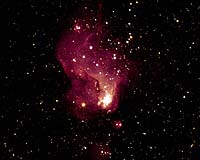
Resembling curling flames from a campfire, this magnificent nebula in a neighboring galaxy is giving astronomers new insight into the fierce birth of stars as it may have more commonly happened in the early universe.
The glowing gas cloud, called Hubble-V, has a diameter of about 200 light-years. A faint tail of nebulosity trailing off the top of the image sits opposite a dense cluster of bright stars at the bottom of the irregularly shaped nebula.
NASA's Hubble Space Telescope's resolution and ultraviolet sensitivity reveals a dense knot of dozens of ultra-hot stars nestled in the nebula, each glowing 100,000 times brighter than our Sun.
These youthful 4-million-year-old stars are too distant and crowded together to be resolved from ground-based telescopes. The small, irregular host galaxy, called NGC 6822, is one of the Milky Way's closest neighbors and is considered prototypical of the earliest fragmentary galaxies that inhabited the young universe. The galaxy is 1.6 million light-years away in the constellation Sagittarius.
Hubble's spectacular resolution allowed a group of European and American astronomers to pinpoint individual stars in this crowded region and measure their brightness and temperatures. (Hubble-V represents one of two star-birth regions studied by the astronomers.)
They made their extensive analysis because of the telescope's ability to detect ultraviolet light, which is emitted by the hottest young stars. Their analysis has provided a better understanding of the populations of stars inside the cloud.
Hubble's sharp "eye" also allowed the astronomers to estimate the temperatures, brightness, ages, and masses of many stars. From this information, the astronomers determined that many of the stars formed at the same time.
The hot, massive stars emit a tremendous amount of radiation, which sculpted and illuminated the large gas cloud in which the stars were born. The cloud is actually composed of several "bubbles" of gas blown by the hefty stars. The hot radiation also energizes the gas, making it glow.
Besides unleashing powerful ultraviolet radiation, the massive stars also lose a significant amount of mass in "stellar winds." These winds travel at supersonic speeds (up to 6.7 million miles an hour or 10.8 million kilometers an hour), carrying away up to more than a solar mass per star every million years.
The winds slam into the surrounding gas cloud, and may play a major role in triggering star formation of smaller-mass stars. The young stellar families in Hubble-V are revealing the exact roles of all the stars in a stellar breeding ground. Hubble-V resides in a galaxy called NGC 6822, 1.6 million light-years away.
Why are these very massive stars so important?
