
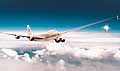
The US Airforce, Boeing, Lockheed Martin and TRW recently completed a successful series of tests at Lockheed Martin's Advanced Technology Center, Palo Alto, Calif., demonstrating the Airborne Laser (ABL) weapon system will provide lethality consistent with the Air Force's concept of operations when performing in real theater atmospheres. The successful performance of the ABL Beam Control Laboratory Demonstrator (BCLD) answered several critical issues concerning ABL's beam propagation and range performance variability when it is subjected to various levels of real world atmospheric turbulence.
"This is one more step in the incremental build and test philosophy
of the Airborne Laser weapon system," said Paul Shattuck, ABL
program manager for Lockheed Martin. "Our Beam Control risk
reduction activities run the gamut of component technology
maturation, manufacturing, process validation and predictions of
end-to-end system performance. The results from these latest tests
validate the tracking, pointing hardware and algorithms approach
necessary for the ABL weapon system to perform under real world
atmospheric conditions."
Tests performed by the BCLD included three different experiment
arrangements that correspond to atmospheric field data collected by
the Air Force. All experiments conducted by the BCLD demonstrated
sufficient ABL performance, thus indicating acceptable range
variability for these real theater atmospheres.
For the past six years, Team ABL has been predicting the system's
performance with a variety of tools. Multi-prong performance
validation of these predictions was attained by using the following:
Detailed analytic simulation codes that were anchored to real world
and laboratory measurements (i.e., detailed correlation of analytic
results and real world observation)
Scaled tracking, pointing and atmospheric compensation that was
field tested at MIT/Lincoln Lab Firepond, Mass., and White Sands
Missile Range, N.M.
BCLD, which shows ABL capability when using representative beam
control system (BCS) arrangement, engagement geometries (range,
target and velocities) and atmospheres
The BCLD is a tool that will help take the risk out of developing
the ABL system. "The BCLD is a replica of the real ABL Beam
Control system. It maintains careful scaling of diffraction losses,
turbulence effects, and ratio of control to atmosphere bandwidth," said
Shattuck. "Although some ABL optics are not present — for example
the ABL telescope — those that control the high-risk functions are
there in scaled fashion. While full system performance of the real ABL
BCS is not expected, the functional and operational performances are
representative."
The BCLD is especially useful for two purposes. First, it anchors
analytic codes like ABLWOC (adaptive optics and laser beam
propagation predictions) and Pathfinder (platform jitter predictions).
Second, it optimizes component and system performance by making
parametric measurements where performance changes are measured
when a parameter such as optical alignment, fast steering mirror
bandwidth, software algorithm, or atmospheric turbulence is changed.
"Both of these BCLD uses will maintain our vigorous ABL
program to increase fidelity in our performance predictions and to
continue a risk buydown program until the demonstration of missile
shoot-down in year 2002." said Dr. Ken Billman, the BCS chief
scientist.
Team ABL's current Program Definition and Risk Reduction
(PDRR) contract with the Air Force calls for the team to produce,
integrate and flight test the first prototype ABL demonstration system.
The contract is scheduled to culminate in 2002 with a boost-phase
shoot-down of a theater ballistic missile. An ABL engineering,
manufacturing and development (EMD) program could begin as early
as 2003. The PDRR aircraft will provide the Air Force with a residual
operational capability.
Team ABL is led by Boeing, which has overall program
management and systems integration responsibilities. The company is
also developing the ABL battle management system and modifying the
747-400 aircraft. Those efforts will be done at Boeing facilities in
Seattle and Wichita, Kan. TRW, Redondo Beach, Calif., is building the
laser and the related ground-support subsystem, while Lockheed
Martin Missiles & Space, Sunnyvale, Calif., is developing the ABL
target acquisition and beam control systems.
