
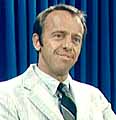
Alan B. Shepard, Jr., the first American to fly in space and one of only 12 humans who walked on the Moon, died Tuesday night after a lengthy illness in Monterey, CA. He was 74.
Shepard died at Community Hospital on the Monterey
Peninsula, according to his family. The cause of death was not
disclosed. Funeral services are pending.
"The entire NASA family is deeply saddened by the
passing of Alan Shepard. NASA has lost one of its greatest
pioneers; America has lost a shining star," said NASA
Administrator Daniel S. Goldin.
"Alan Shepard will be remembered, always, for his
accomplishments of the past; being one of the original Mercury
astronauts, for being the first American to fly in space, and for
being one of only 12 Americans ever to step on the Moon. He should
also be remembered as someone who, even in his final days, never
lost sight of the future," Goldin added.
"On behalf of the space program Alan Shepard helped launch,
and all those that the space program has and will inspire, we send
our deepest condolences to his wife, Louise, their children, and
the rest of the Shepard family.
Alan Shepard lived to explore the heavens. On this final
journey, we wish him Godspeed."
"Alan Shepard is a true American hero, a pioneer, an
original. He was part of a courageous corps of astronauts that
allowed us to reach out into space and venture into the unknown,"
said George W.S. Abbey, Director of the Johnson Space Center,
Houston, TX. "Alan Shepard gave all of us the privilege to
participate in the beginnings of America's great adventure of
human space exploration. He will be greatly missed. The program
has lost one of its greatest supporters and a true friend. Our
thoughts and prayers are with his wife, Louise, and their family."
Named as one of the nation's original seven Mercury
astronauts in 1959, Shepard became the first to carry America's
banner into space on May 5, 1961, riding a Redstone rocket on a
15-minute suborbital flight that took him and his Freedom 7
Mercury capsule 115 miles in altitude and 302 miles downrange from
Cape Canaveral, FL.
His flight followed by three weeks the launch of Soviet
cosmonaut Yuri Gagarin, who on April 12, 1961, became the first
human space traveler on a one-orbit flight lasting 108 minutes.
Although the flight of Freedom 7 was brief, it nevertheless
was a major step forward for the U.S. in a rapidly-accelerating
race with the Soviet Union for dominance in the new arena of
space.
Buoyed by the overwhelming response to Shepard's flight, which
made the astronaut an instant hero and a household name, President
John F. Kennedy set the nation on a course to the Moon, declaring
before a joint session of Congress just three weeks later, "I
believe this nation should commit itself to achieving the goal,
before the decade is out, of landing a man on the Moon and
returning him safely to the Earth."
Over a three and a half year period from July 1969 to December
1972, a dozen Americans explored the lunar surface. Shepard was
the fifth man to walk on the Moon, and the oldest, at the age of
47.
Shepard, however, was almost bypassed for a trip to the moon.
He had to overcome an inner ear problem called Meuniere's syndrome
that grounded him for several years following his initial
pioneering flight.
An operation eventually cured the problem and Shepard was
named to command the Apollo 14 mission. On January 31, 1971,
Shepard, Command Module pilot Stuart Roosa and Lunar Module pilot
Edgar Mitchell embarked for the Moon atop a Saturn 5 rocket.
Shepard and Mitchell landed the lunar module Antares on February 5
in the Fra Mauro highlands while Roosa orbited overhead in the
command ship Kitty Hawk.
Shepard planted his feet on the lunar surface a few hours
later, declaring, "Al is on the surface, and it's been a long way,
but we're here." During two excursions on the surface totaling
nine hours, Shepard and Mitchell set up a science station,
collected 92 pounds of rocks and gathered soil samples from the
mountainous region.
Near the end of the second moonwalk, and just before entering
the lunar module for the last time, Shepard (an avid golfer) hit two
golf balls with a makeshift club. The first landed in a nearby
crater. The second was hit squarely, and in the one-sixth gravity
of the moon, Shepard said it traveled "miles and miles and miles."
Shepard's death leaves only four survivors among the original
Mercury 7 astronauts: Sen. John Glenn, Scott Carpenter, L. Gordon
Cooper and Walter Schirra.
Born Alan Bartlett Shepard, Jr. on Nov. 18, 1923, in East
Derry, NH, he received a Bachelor of Science degree from the
United States Naval Academy in 1944. Upon graduation, he married
Louise Brewer, whom he met while at Annapolis. Shepard received
his wings as a Naval aviator in 1947 and served several tours
aboard aircraft carriers. In 1950, he attended Naval Test Pilot
School at Patuxent River, MDS, and became a test pilot and
instructor there. He later attended the Naval War College at
Newport, RI, and after graduating, was assigned to the staff of
the commander-in-chief, Atlantic Fleet, as an aircraft readiness
officer.
In August 1974, Shepard, then a rear admiral, retired from
both NASA and the Navy and became chairman of Marathon
Construction Corp. in Houston. He later founded his own business
company, Seven Fourteen Enterprises, named for his two missions on
Freedom 7 and Apollo 14.
In 1984, he and the other surviving Mercury astronauts, along
with Betty Grissom, the widow of astronaut Virgil I. (Gus)
Grissom, founded the Mercury Seven Foundation to raise money for
scholarships for science and engineering students in college. In
1995, the organization was renamed the Astronaut Scholarship
Foundation. Shepard was elected president and chairman of the
foundation, posts he held until October 1997, when he turned over
both positions to former astronaut James A. Lovell.
Survivors include his widow, Louise, daughters Julie, Laura
and Alice and six grandchildren.
The family has requested that in lieu of flowers, donations be
made to the Astronaut Scholarship Foundation, 6225 Vectorspace
Boulevard, Titusville, FL, 32780.
