
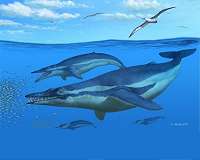
Whales once ignored krill, and instead stalked sizable prey, new research suggests.
Whales haven't always been predominantly filter feeders. Baleen whales — the world's preeminent filter feeders and the largest mammals in the world — used to have well-defined teeth.
But until now, researchers weren't exactly sure how ancient whales put their teeth to use. New analysis of ancient whale fossils suggests their teeth were surprisingly sharp.
Paleontologists at Monash University in Melbourne, Australia, used 3D scanners to image ancient whale jaws and teeth from fossils collections all over the world. The researchers used their analysis to model the teeth of ancient baleen whales, the ancestors of the southern right whale and the blue whale.
Their models revealed sharp, powerful teeth capable of chomping large fish.
"Predators that kill and chew their prey need sharp teeth with cutting blades," Alistair Evans, an associate professor of biological sciences at Monash, said in a news release. "By contrast, species that use their teeth as a sieve have blunt teeth with rounded edges that help to filter prey from water."
"We found that ancient whales had sharp teeth similar to lions and dingoes so it likely they used their teeth to kill rather than filter," Evans said.
The latest findings — detailed this week in the journal Biology Letters — suggests filter feeding emerged later in the evolution of whales.
"Our findings provide crucial new insights into how the biggest animals ever evolved their most important trait: filter feeding," Evans said. "Filter feeding is the defining trait of modern whales — there are few ways in which this unique strategy could have evolved from tooth-bearing, predatory ancestors, and our study firmly rules out one of them."
Mexico helped push porpoise to brink of extinction: activists
Mexican fishing authorities have boycotted the effort to save the critically endangered vaquita marina porpoise, environmentalists said Monday, calling them "accomplices" in the near-extinction of the world's smallest porpoise.
While Mexican President Enrique Pena Nieto has embarked on a much-vaunted campaign to save the estimated 30 vaquitas that remain – winning the backing of Hollywood s … read more
