
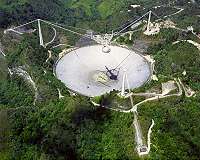
The National Science Foundation has awarded a team of scientists $5.8 million to design and mount a supersensitive antenna at the focal point of the Arecibo Observatory's 1,000-foot-diameter dish, which is managed by the University of Central Florida. The antenna, called a phased-array feed, will increase the telescope's observation capabilities 500 percent.
The team, led by Brigham Young University engineering professors Brian Jeffs and Karl Warnick, includes collaborators at UCF and Cornell University. UCF and its partners have managed the facility since April when the team won a bid from the NSF to run the site.
"We already have one of the most powerful telescopes on the planet, and with this award we will be able to do even more," said Francisco Cordova, Arecibo site director and an engineer. "We are very excited with the award to fund the new ALPACA (Advanced Cryogenic L-Band Phased Array Camera for Arecibo) receiver at the Arecibo Observatory.
This receiver, which is the next generation of our most-used receiver, will be able to increase the survey speed by a factor of five. The receiver will accelerate research in gravitational waves, fast radio bursts, dark matter and pulsar surveys, ensuring that AO continues to be at the forefront of radio astronomy for years to come."
Cordova has been working with BYU for months to prepare the NSF proposal. Jeffs and Warnick are considered the world's foremost experts in phased-array feeds and are familiar with Arecibo. Nine years ago, they installed a gold-plated array of many small antennas at Arecibo that increased the surveying ability of the telescope from one beam of radio waves to seven beams.
The new NSF-sponsored phased-array feed will have 166 antennas and will increase the field of view of the telescope to 40 beams, providing much smoother and continuous coverage of the sky than conventional receivers. The new array is scheduled to be installed by 2022.
"We're taking the most sensitive radio telescope in the world and opening it up so that it can view a larger part of the sky at one time," Warnick said. "There's a lot of things in space you can see with an optical camera, but you can see even more with a radio telescope."
One scientific objective of the new feed will be tracking new pulsars – especially millisecond pulsars that help signal the presence of gravitational waves. Albert Einstein predicted the existence of gravitational waves in 1916, but scientists just detected them a few years ago. Such waves are produced by catastrophic events, such as two colliding black holes, and they cause ripples in the fabric of space-time.
The phased-array feed will also search for extraterrestrial intelligence, detect fast radio bursts and conduct surveys to help unravel the mystery of dark matter in the universe.
"Every galaxy in the universe has an invisible cloud of dark matter around it that we don't yet understand," Warnick said. "This will help solve one of the mysteries of the universe."
