
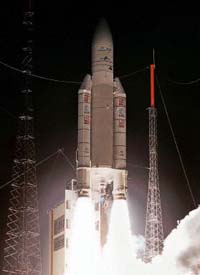
An Ariane-5 rocket blasted off in French Guiana on Friday and successfully placed a Japanese television and a French military satellite into orbit, the company said. The JCSAT-10 satellite successfully separated 27 minutes and seven seconds after liftoff from the Kourou space centre, followed by the French Syracuse 3B satellite at 32 minutes and 50 seconds.
The JCSAT-10 satellite was built by Lockheed Martin for Japan's JSAT corporation, and should ensure high definition television coverage for Japan, the Asia-Pacific region and Hawaii.
The Syracuse 3B, along with a sister satellite put into orbit last year, will help provide secure communications to the French military outside of France.
"This launch marks an important increase in the operational capabilities of our armed forces, particularly while they are deployed abroad," French Prime Minister Dominique de Villepin said in a statement.
The third Ariane space launch this year and the 172nd since the company was founded in the 1980s, it was the sixth flight of an Ariane-5 ECA rocket, a heavy-duty version of the European Space Agency's (ESA) workhorse Ariane-5 series capable of putting 10 tonnes into orbit.
"Tonight's success is particularly exemplary, and perfectly illustrates why we have launched a total of 237 satellites during the past 26 years — which, by far, is a world record," Arianespace Chief Executive Officer Jean-Yves Le Gall said after the launch, according to a statement.
Arianespace's next launch is planned for mid-September, with another Ariane-5 carrying a US television satellite, an Australian communications satellite and an experimental Japanese satellite.
JCSAT – 30th Consecutive A2100 Success For Lockheed Martin
Initial contact with the JCSAT-10 satellite, called acquisition of signal, was confirmed at 7:07 p.m. EDT from Lockheed Martin's satellite tracking station in Uralla, Australia.
The successful launch of JCSAT-10 represents the 30th launch of an A2100 spacecraft for customers worldwide and all 30 currently are operational. The first A2100 was launched in 1996. Built by Lockheed Martin Commercial Space Systems (LMCSS), Newtown, Pa., JCSAT-10 is the fourth in a series of six A2100 satellites planned this year and the second of three satellites the company will deliver to JSAT. JCSAT-9 was launched earlier this year and JCSAT-11 is scheduled for launch in 2007.
"We are proud to deliver another outstanding spacecraft to one of our premier customers, JSAT," said LMCSS President Ted Gavrilis. "The 30th straight successful A2100 launch is a testament to Lockheed Martin's commitment to excellence and mission success for our customers. Congratulations are in order to the entire team and we look forward to continuing our record of mission success for the remainder of 2006 and beyond."
Based on Lockheed Martin's A2100AX satellite bus, JCSAT-10 is a high-power hybrid satellite consisting of 30 active Ku-band transponders and 12 active C-band transponders that will provide coverage to Japan, the Asia-Pacific region and Hawaii. JCSAT-10 will operate from 128 degrees east and is designed for a minimum service life of 15 years.
Ariane 5 Flight timeline
