
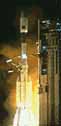
Liftoff from the Guiana Space Center in Kourou, French Guiana took place on Friday, September 3, 1999 at 7:34 p.m. local time (22H34 GMT, 6:34 p.m. in Washington, DC; and on Saturday, September 4, at 12:34 a.m. in Paris and 7:34 a.m. in Seoul, South Korea).
"Going from success to success, Arianespace supports the development of satellite communications around the world!" Arianespace Chairman and CEO Jean-Marie Luton said following the successful mission. "The choice of Europe¿s Ariane launcher by Korea ¿ a country on the cutting edge of telecommunications technology ¿ bolsters our position in the Asia-Pacific region, where we have already signed 37 launch contracts."
Flight 120 was performed by an Ariane 42P, the Ariane 4 version with two solid-propellant strap-on boosters. This mission used the 88th out of 116 Ariane 4 launchers ordered to date from the European space industry, and it marked the 46th successful launch in a row for Ariane 4.
Provisional parameters at third stage injection were:
Perigee: 199.8 km. for a target of 199.8 km (¿3 km)
Apogee: 39,950 km. for a target of 35,955 km (¿150 km)
Inclination: 7.00 degrees for a target of 7.00 degrees (¿0.06¿)
Koreasat 3 is Korea Telecom's third telecommunications satellite. Built by Lockheed Martin Communications Space Systems in Sunnyvale, California, Koreasat 3 weighed 2,800 kg. (6,160 lb.) at liftoff, and is equipped with 30 Ku-band and 3 Ka-band transponders. Koreasat 3 will be positioned at 116¿ East, allowing the leading Korean telecom operator to ensure the continuity and development of services throughout the Asia-Pacific region.
The next launch, Arianespace Flight 121, is scheduled for the morning of September 24, 1999 (Kourou local time). An Ariane 44LP will place into orbit the Telstar 7 telecommunications satellite for operator Loral Skynet.
Following Flight 120, Arianespace's order book now stands at 42 satellites to be launched.
