
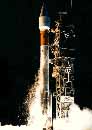
A Lockheed Martin Astronautics Atlas IIAS rocket successfully launched a GE-3 commercial communications satellite into supersynchronous transfer orbit this morning from
Complex 36, Pad A, at Cape Canaveral Air Station (CCAS), Fla. Liftoff occurred right on time at 8:03 a.m. Eastern Daylight Time. It was the fifth successful Atlas launch of 1997 from CCAS and the thirty-second consecutive successful flight for Atlas.
The Atlas IIAS, designated AC-146 for the GE-3 mission, is the most powerful of the Atlas configurations presently launching
payloads for commercial, military and government customers. Booster performance is increased through the use of four
strap-on solid rocket boosters. The Atlas II series, including the II, IIA and IIAS, has had 100 percent operational success
since the introduction of each launch vehicle.
Once in final orbit at 87 degrees west, GE-3 will join the rest of GE American Communication's (GE Americom) commercial
domestic satellite fleet and provide educational cable television, broadcast television and radio, private business and government
communications services to the 50 U.S. states and Alaska. GE-3 is the third A2100A satellite built by Lockheed Martin for GE
Americom.
Lockheed Martin has commitments for 27 Atlas launches through the 1990s, including 19 commercial and 8 Air Force
missions. Four more missions remain in the 1997 manifest.
Atlas and the Centaur upper stage are built by Lockheed Martin Astronautics at facilities in Denver, Colo.; Harlingen, Tex.; and
San Diego, Calif. Major suppliers to the Atlas program include Rocketdyne, a division of Boeing North American located in
Canoga Park, Calif., Atlas MA-5A engines; Pratt & Whitney, located in West Palm Beach, Fla., Centaur upper stage RL-10
engines; Honeywell Space Systems of Clearwater, Fla., inertial navigation unit; and Thiokol Corp. of Ogden, Utah, Castor IVA
solid rocket boosters. International Launch Services, headquartered in
San Diego, Calif. ILS was formed in 1995 to jointly market commercial launch services on Atlas and the Russian-built Proton
launch vehicles.
