
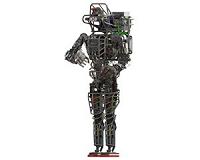
When Boston Dynamics first unveiled its ATLAS robot in July of 2013, tech experts were impressed with its human-like legs and frame, but its movements were still thoroughly robotic — awkward and clunky.
Over the last year, engineers at Google-owned Boston Dynamics have been working with scientists at the Florida Institute for Human and Machine Cognition to improve ATLAS's programming. That work has paid off, as ATLAS's gait and movements have been smoothed out and streamlined.
Now with the software to match its impressive hardware, ATLAS is not only walking more like a human, it's also balancing on one leg and performing crane kicks, like a robotic ninja. Researchers say the 330-pound robot could eventually help rescue people from disaster sites that humans can't safely access.
Next summer, ATLAS will resume competition activities in the DARPA Robotics Challenge. The robot already placed first and second, respectively, in the first two phases of the competition, held in 2013. The contest from the Defense Advanced Research Projects Agency calls for semi-autonomous ground robots that can do "complex tasks in dangerous, degraded, human-engineered environments." The winner gets $2 million.
