
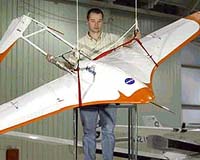
Aurora Flight Sciences Corp. completed construction of a low-speed wind tunnel and tested it successfully last week. The open-circuit wind tunnel, built inside a standard 20-ft shipping container, has a 3-blade propeller, driven by a 75-hp motor, which feeds air through a settling chamber and out through a 6- by 4-ft exit section.
A model being tested is supported by an adjustable steel-tube frame in the flow coming from the exit section. This open test-section arrangement maximizes access to the model and allows flexibility for configurations that would be problematic if there were walls around the test section.
The wind tunnel operator can adjust the pitch of the propeller blades to provide airspeeds of up to 35 meters per second (68 knots) in the test section.
Electronic sensors and a computerized data acquisition and control system provide highly automated testing of models in the wind tunnel. The computer can control angle-of-attack settings, surface positions, and even propeller speeds on the model.
A six-axis load cell, solid-state pressure sensors, and other sensors record force, moment, pressure, and other data relevant to aerodynamics and control.
Because the computer performs these functions autonomously, it can record a large number of data points in a very short time period, which enables quick design cycles and reduces overall costs when compared with other systems. Manual control and data recording are also supported.
Aurora Flight Sciences Project Leader Jean-Charles Led¿ noted, "The wind tunnel will prove to be a versatile design and evaluation tool for our rapid-development aircraft projects." Prototype shop head Jim Hayes and lead engineer Larry Baskett coordinated the construction effort.
Aurora Flight Sciences is a leading supplier of unmanned air vehicle (UAV) designs, components, and flight services for government, industry, and academia. Operating facilities in West Virginia, Northern Virginia, and California, Aurora specializes in high-altitude UAVs and is a major supplier of composite structures for the Global Hawk air vehicle.
