
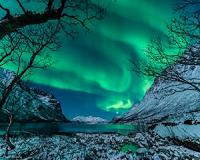
September kicks off more than football – it's aurora season! Join Marshall Center scientist Jim Spann on Tuesday, Sept. 9 to chat about auroras. The chat window will go live on this page at 2:00 p.m. EDT.
Auroras are simply the greatest light show on Earth and the most obvious evidence of space weather and the connection between the Earth and the sun. Both spring and autumn are good aurora seasons, with winter and summer offering less storms and limited viewing options.
Autumn is special in part because pleasant evenings tempt skywatchers outside to watch the skies. However, autumn really does produce a surplus of geomagnetic storms — almost twice the annual average.
The aurora is caused by energized particles (protons and electrons) that travel along the Earth's magnetic field and come crashing into the Earth's atmosphere near the north and south pole, and collide with the atmospheric constituents of nitrogen and oxygen. The molecular nitrogen and atomic oxygen absorb some of the energy from the collision and then release it in the form of light. The colors and intensity of the light form the aurora.
The violet and blues lines are dominated by emissions from ionized molecular nitrogen (N2+), the green line at 557.7 nm and the red lines near 630 nm by emissions from atomic oxygen (O), and the red lines above 640 nm by emissions from molecular nitrogen (N2).
The auroral emissions are also height dependent because particles with higher energies can penetrate deeper in the atmosphere; the oxygen red lines are generally emitted at higher altitudes than the green lines.
The sudden onset of auroral intensity and activity is called a magnetic or auroral storm. It usually occurs around 60 magnetic latitude near midnight. The best time to see the aurora with the naked eye is during a clear night near just after midnight around the equinox and through the winter. But aurora, however dim and quiescent, is always present day and night.
An auroral storm is driven by explosive events on the sun where energy is expelled as a magnetized plasma cloud and becomes part of the solar wind. If this plasma cloud happens to collide with the Earth, its magnetic field becomes energized and is stretched in the direction of the solar wind, much like a wind sock is stretched on a windy day and points in the direction of the wind.
At some point the energy in the Earth's magnetic field is released, like a stretched rubber band that is released, and accelerates electrons and protons back toward the Earth along the magnetic field lines, and causes the aurora.
