
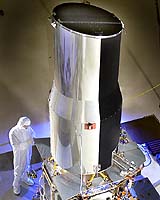
Onboard the Space Infrared Telescope Facility (SIRTF), now in orbit, are two scientific instruments and a unique cooled telescope system built at Ball Aerospace & Technologies Corp. in Boulder.
The Cryogenic Telescope Assembly, or CTA, built at Ball Aerospace, is the "eyes" of SIRTF, with a lightweight telescope and cooling technology that allow it to see the faint infrared light produced by young galaxies, brown dwarfs and other cosmic objects.
The unique cooling system aboard the CTA allows SIRTF to be launched "warm." Once in space, the telescope is cooled to its operating temperature of 5 degrees above absolute zero (about 450 degrees below zero, Farenheit). This warm launch technique has never before been used. It will conserve the liquid helium coolant and enable a mission length of between two and one half years to five years in duration.
Ball Aerospace was responsible for building two of SIRTF's three scientific instruments. The Infrared Spectrograph (IRS) will provide SIRTF with low and moderate spectral-resolution spectroscopic capabilities.
The Multiband Imaging Photometer (MIPS) is a far-infrared instrument capable of imaging photometry, high-resolution imaging, and scan mapping. The detectors used in these instruments are 1,000 times more sensitive than those used in any previous space mission, and will give astronomers unprecedented views of our universe.
SIRTF is the fourth, and last, component of NASA's family of Great Observatories, which study a wide variety of astronomical phenomena. The long-wave infrared capability of the SIRTF provides a unique scientific complement to the Hubble Space Telescope (which provides images and data from ultraviolet, visible and short-wave infrared light) and the Chandra X-Ray Observatory (which provides data from X-ray light).
The Compton Gamma Ray Observatory was removed from orbit by NASA in 2000 after a successful nine-year mission that provided data on the universe's high-energy gamma rays. SIRTF's infrared capabilities will pierce through heavy space dust and allow astronomers to study newly formed stars and other celestial bodies.
Ball Aerospace played a chief role in all four of NASA's Great Observatories by building science instruments, optical systems, cryogenic systems, mechanisms and electronics. SIRTF is managed by NASA's Jet Propulsion Laboratory in Pasadena, Calif.
