
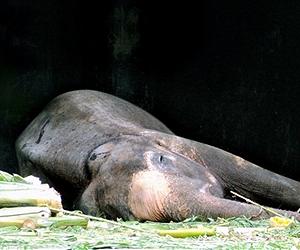
Bangladesh's biggest zoo has declared three days of mourning following the death of a 100-year-old elephant which was its top attraction and "loyal servant," an official said Saturday.
Pabantara collapsed Thursday after a heart attack and died hours later, plunging her fans into grief, A.H.M Shahidullah, head of the state-owned Dhaka Zoo, told AFP.
The female Asian elephant had lived at the zoo since it was founded in 1957 and had carried hundreds of thousands of children and adults on fun rides — a key activity at the zoological garden.
"All the mahouts (caretakers) and those who knew Pabantara cried like babies over her death," Shahidullah said.
"Some mahouts who retired from the zoo came all the way from their villages to be at her side. They prayed and lit candles and incense at her grave," he said.
During the mourning period, which began on Friday and will finish on Sunday, "there will be no fun-rides on the other elephants," he said.
"We will hold special prayers at a mosque to seek eternal blessings for Pabantara and other animals who are ill," Shahidullah added.
Pabantara had been a huge money spinner for the zoo on the northern outskirts of Dhaka, capital of the mainly Muslim country.
"She also was one of the oldest Asian elephants in this region. She was always peaceful and friendly. She was one of the most favourite animals and a loyal servant of the zoo. She deserves respect," Shahidullah added.
Shahidullah said veterinarians had examined her teeth and concluded that Pabantara was aged "around 100 years".
The elephant had been buried on the zoo grounds, Shahidullah said.
Asian elephants normally live between 60 and 90 years, said Mohsinuzzman Chowdhury, the country's top elephant expert, but can live beyond 100 years.
The zoo is home to about 2,000 animals and stretches over a 753,000-square-metre (186-acre) park.
It is one of the few open spaces in a crowded city that is home to more than 12 million people.
earlier related report
Study: Time is short for African apes
Roehampton, England (UPI) Jul 22, 2010 –
Global warming could threaten African ape survival by depriving apes of sufficient time for such basic daily survival skills as finding food, researchers say.
British scientists said rising world temperatures and shifts in rainfall patterns could cause chimpanzees to lose up to 50 percent and gorillas up to 75 percent of their remaining habitats, a study published in the Journal of Biogeography said Thursday.
Increased temperatures mean ape species have to rest more and more often to avoid overheating, causing them to run out of time for daily survival activities, making some marginal habitats uninhabitable, the study said.
"In reality, the effects of climate change on African apes may be much worse, as our model does not take into account possible anthropogenic effects, such as habitat destruction by humans and the hunting of apes for bushmeat," Julia Lehmann of Roehampton University said.
Global warming threatens to have strong effects on ape behavior, distribution and survival, pushing them even further to the brink of extinction, the study said.
Share This Article With Planet Earth
