
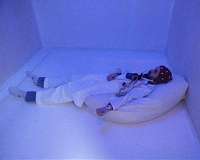
Researchers from the University of Granada (UGR), in collaboration with the School for Special Education San Rafael (Hospitaller Order of Saint John of God, Granada, Spain) have proven, by means of an objective evaluation using electrophysiological measurements, that blue lighting accelerates the relaxation process after acute psychosocial stress in comparison with conventional white lighting.
Said stress is a kind of short-term stress (acute stress) that occurs during social or interpersonal relationships, for example while arguing with a friend or when someone pressures you to finish a certain task as soon as possible.
The researchers, which belong to the BCI Lab (Brain-Computer Interface Lab) at the University of Granada, note that psychosocial stress produces some physiological responses that can be measured by means of bio-signals. That stress is very common and negatively affects people's health and quality of life.
For their work, whose results have been published in the PlosOne journal, the researchers made twelve volunteers to be stressed and then perform a relaxation session within the multisensory stimulation room at the School for Special Education San Rafael.
In said room the participants lied down with no stimulus but a blue (group 1) or white (group 2) lighting. Diverse bio-signals, such as heart rate and brain activity, were measured throughout the whole session (by means of an electrocardiogram and an electroencephalogram, respectively).
The results showed that blue lighting accelerates the relaxation process, in comparison with conventional white lighting.
The research was led by Francisco Pelayo (Department of Computer Architecture and Technology), and it was carried out by researcher Jesus Minguillon, professor Miguel Angel Lopez Gordo (Department of Signal Theory, Telematics and Communications) and the bachelor student Diego Adrian Renedo Criado, in collaboration with Dr. Maria Jose Sanchez Carrion (PhD in Psychology, School for Special Education San Rafael).
The path length of light in opaque media
What happens when light passes through a glass of milk? It enters the liquid, is scattered unpredictably at countless tiny particles and exits the glass again. This effect makes milk appear white. The specific paths that the incident light beam takes depends, however, on the opacity of the liquid: A transparent substance will allow the light to travel through on a straight line, in a turbid subs … read more
