
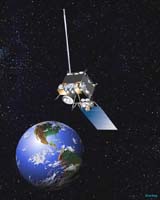
Boeing announced Wednesday that GOES-N – the first of three Geostationary Operational Environmental Satellites built for NASA and the NOAA – has reached its orbital slot 22,300 miles above the equator, and Boeing engineers have transferred control of the satellite to NASA.
Following its launch last month on a Boeing Delta IV rocket, the advanced satellite completed orbit-raising and key on-orbit operations such as spacecraft initialization and checkout.
Boeing said it completed this key milestone, known as engineering handover, two days ahead of schedule.
"GOES-N has performed exceptionally well following a perfect launch last month, which has allowed us to achieve this milestone ahead of schedule," said Stephen T. O'Neill, president of Boeing Satellite Systems International, Inc.
NASA now is operating GOES-N and conducting a six-month post-launch test program from the NOAA Satellite Operations Control Center in Suitland, Md. Boeing will advise NASA and NOAA engineers during the test program.
After the program concludes, NASA will deliver GOES-N to NOAA for all future operations. On June 4, after GOES-N achieved geosynchronous orbit, NOAA renamed the spacecraft GOES 13.
Designed and manufactured at Boeing's Satellite Development Center in El Segundo, Calif., the GOES-N series is based on the three-axis Boeing 601 model satellite. The spacecraft's technology should improve image accuracy by a factor of four using a more stable instrument platform and a precise geosynchronous stellar inertial attitude determination and control system, Boeing said in a news release.
GOES-N's capabilities should support more accurate prediction and tracking of severe storms and other weather phenomena, resulting in earlier and more precise warnings to the public, the release continued.
GOES-N will support NOAA and NASA scientists collecting and analyzing real-time environmental data as well as rescuers responding to calls for help through a communication subsystem that includes a search and rescue capability to detect distress signals from land, sea and air.
Boeing has completed GOES-O, which currently sits in storage awaiting launch. GOES-P is undergoing final assembly and space environmental testing and is scheduled for completion within the next several months.
