
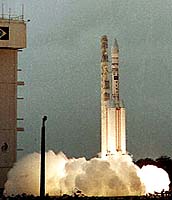
Nov. 3, 1997 – Brazil's first attempt at joining the world's space powers ended in failure a minute after launch Sunday when the VLS-1 space booster exploded in mid-air above the Alcantara Spaceport on the Atlantic coast. Aboard the launcher was the Brazilian SCD2 research satellite, built by the Space Research Institute of Brazil. Ground controllers destroyed the 65-ft tall rocket at an altitude of 9,000 feet when it veered off course due to an engine malfunction.
The VLS launch capped a decade-long development program by the government
of Brazil in the development of an indigenous space booster. The all-solid
rocket can place payloads ranging from 200 to 700 pounds into low, 400 mile
high orbits. The equatorial launch site of Alcantara makes the new
Spaceport an attractive location with the potential of hosting commercial
space boosters in the future. The setback may cause months of redesign
before the VLS can be launched again.
Since the mid-1960's Brazil has developed a series of advanced solid fuel
rockets used to excplore the upper atmosphere. Named the Sonda or sounding
rocket family, the series was among the world's most advanced research
rockets for scientific atmospheric research. The VLS was an evolved version
of the largest sounding rocket, Sounda 6 and featured upper stages that
could inject small satellites into orbit, an advance over the less powerful
Sounda series.
