
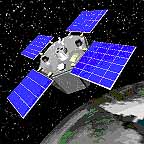
NASA's Active Cavity Radiometer Irradiance Monitor (AcrimSat) — a satellite designed to measure the total amount of sunlight falling on Earth's atmosphere, oceans and land, and improve predictions of long-term climate change — lifted off at 11:13 p.m. Pacific Standard Time December 20 aboard a Taurus rocket.
The night launch from Space Launch Complex 576 East at Vandenberg Air Force Base, CA, begins a five-year science mission to monitor incoming solar radiation and help scientists determine whether an increase in sunlight is contributing to a rise in global temperatures.
The Active Cavity Radiometer Irradiance Monitor sun sensor, managed by NASA's Jet Propulsion Laboratory, Pasadena, CA, is the third in a series of missions to measure variations in total incoming solar energy, known as total solar irradiance.
The solar-monitoring satellite, a secondary payload riding along with the primary Korea Multi-Purpose Satellite, was deployed 16 minutes after launch, at 11:29 p.m., some 90 seconds after the primary satellite was released.
Ground controllers at the McMurdo Ground Station in Antarctica acquired AcrimSat's signal about 20 minutes after launch, at about 11:33 p.m. The 115-kilogram (253-pound) satellite is currently circling Earth from a polar orbit at an altitude of 685 kilometers (425 miles).
The satellite operations team will monitor spacecraft health, including AcrimSat's operating temperature, state of battery charging, Sun-pointing performance and the overall condition of all onboard systems in the next two weeks.
Once all systems have been checked, instrument checkouts will be conducted to assure normal performance of the sun sensors before science operations begin.
