
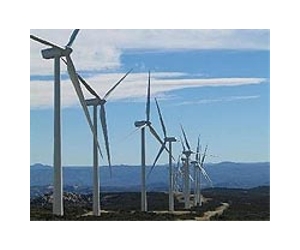
Under a new regulation adopted Thursday, 33 percent of California's electricity would come from renewable sources by 2020.
The target, approved by the Air Resources Board, is expected to reduce greenhouse gas emissions by the equivalent of 12 million to 13 million metric tons of carbon dioxide per year in 2020.
"The Renewable Electricity Standard means cleaner energy for California's households and businesses," said board Chairwoman Mary Nichols in a statement.
"This standard is going to further diversify and secure our energy supply while also growing California's leading green technology market, which will lead to cost savings for consumers."
The regulation will follow interim targets, starting with 20 percent for 2012-14, 24 percent for 2015-17, 28 percent for 2018-19 and 33 percent for 2020 and beyond.
The board said by 2020, the cost of implementing the regulation would be $2.5 billion. That would increase energy costs less than 1 cent per kilowatt hour.
California Gov. Arnold Schwarzenegger welcomed the new standard, saying, "With this long-term energy policy, California will continue to lead the transition to a clean-energy future and away from being so dependent on the volatile prices and harmful emissions of dirty oil and coal," Environment News Service reports.
There are now more than 200 renewable energy projects looking to build and do business in the state, Schwarzenegger added.
Just Wednesday, the California Energy Commission approved the Ivanpah Solar Electric Generating System project in the Mojave Desert, the fourth large-scale solar power facility in the state to get the green light during the past month.
But some business and consumer organizations are concerned that the new ruling could result in higher utility bills.
"There must be a safety valve to protect retail customers," said Matthew Freedman, an attorney at San Francisco's Utility Reform Network, in a statement.
The regulation also allows utilities to buy renewable energy credits to meet their entire requirements, instead of actually generating energy from renewable sources. The credits would pay for renewable energy generated in other states or even other countries such as Canada or Mexico.
That means California utilities could still generate power using coal, oil or gas, said Laura Wisland, energy analyst at the Union of Concerned Scientists, Environment News Service reports.
"California doesn't get any power for that purchase, so we get no greenhouse gas reduction benefits, no air quality improvements and no clean jobs," she said.
Share This Article With Planet Earth
