
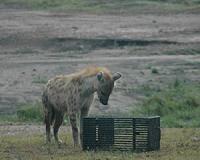
Conservationists have revealed an impressive series of new images from one of the largest camera trap surveys in Africa.
The new photographs, captured by motion sensor cameras, reveal a variety of predators and prey, big and small, within Angola's portion of the Kavango-Zambezi Transfrontier Conservation Area, or ZAZA, a wildlife park that encompasses the convergence of five African nations.
The survey has returned imagery of elephants, honey badgers, hyenas, lions, panthers, porcupines and many more species.
In addition to the southeastern corner of Angola, ZAZA also includes portions of Botswana, Namibia, Zambia and Zimbabwe.
Of the five ZAZA nations, Angola's park acreage is the least studied. The camera traps were placed in Angola's portion of ZAZA to give conservationists a better sense of the animals there — knowledge that wildlife officials can use to better protect endangered species.
The survey effort has been aided by scientists, conservationists and other officials with Fauna and Flora International, Angola National Institute of Biodiversity and Conservation Areas and the Panthera Corporation.
White lions and tigers born in Polish zoo
Borysew, Pologne (AFP) Sept 22, 2016 –
Three white tigers were born at a Polish zoo on Thursday, just days after the private facility welcomed another rare litter of four white lion cubs.
Born Sunday, the lions joined an already large family numbering parents Azira and Sahim and their eight other children.
"We've expanded the global population by 15 percent," owner Andrzej Pabich said of the white lions raised at his zoo in the central village of Borysew.
"The selection process is a lot of work, then we have to choose the right food and create the right environment to have this many offspring," he told AFP.
White lions and tigers are both extremely rare, numbering only a few hundred worldwide, and owe their appearance to a recessive gene. They are not albino.
