
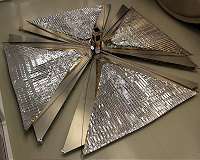
After the CanX-7 nanosatellite deployed its drag sails only a week ago, early results indicate the sails are having a noticeable effect. Space Flight Laboratory (SFL), which developed CanX-7, has announced the altitude decay rate changed significantly following the deployment in the late evening of 4 May 2017 (Toronto time).
A graph of the altitude decay rate shows the aerodynamic drag on the satellite has increased as a result of a changed ballistic coefficient. SFL expects that after a certain amount of time CanX-7 will aerodynamically stabilize due to the so-called "shuttlecock" effect, with all four sails to the rear of the satellite as it travels around Earth.
"This is an earlier-than-expected positive result from CanX-7," explains Dr. Robert Zee, SFL Director. "It confirms and validates the effectiveness of the drag sails in accelerating orbital decay."
The CanX-7 deorbiting demonstration is intended to space qualify SFL-developed drag sail technology. The technology can then be used with confidence to ensure that small satellites comply with Inter-Agency Space Debris Coordination Committee (IADC) guidelines for space debris mitigation. It is an important technology for ensuring that the environment is kept safe for future generations of low Earth orbit missions.
CanX-7
CanX-7 is a 3.5kg nanosatellite built by SFL and funded by Defence R and D Canada (Ottawa), the Natural Sciences and Engineering Research Council, COM DEV Ltd., and the Canadian Space Agency.
The satellite was launched in September 2016. Its two-fold mission is to demonstrate Automatic Dependent Surveillance – Broadcast (ADS-B) message collection from space for global aircraft situational awareness, and to demonstrate deorbiting technology developed by SFL to ensure that small satellites can continue to launch and be successful for generations to come.
SFL builds big performance into smaller, lower cost satellites. Small satellites built by SFL consistently push the performance envelope and disrupt the traditional cost paradigm. Satellites are built with advanced power systems, stringent attitude control and high-volume data capacity that are striking relative to the budget.
NASA Selects Arkansas' First CubeSat
Arkansas' first CubeSat, a small satellite selected by NASA for space education and research, will observe the Earth's climate and measure the composition and concentration of atmospheric gases.
In February, NASA announced the selection of ArkSat-1 as one of 34 satellites from 19 states and the District of Columbia that will be launched into space between 2018 and 2020. ArkSat-1 is being d … read more
