
The United States and its ally on the global warming issue, Australia, on Thursday added new projects, including carbon storage, to a bilateral initiative on climate change, according to a press statement. US Undersecretary of State for Democracy and Global Affairs Paula Dobriansky and Australian Environment Minister Ian Campbell agreed on the additions on the sidelines of the UN climate conference in Nairobi, the US State Department said.
The five projects will "improve understanding of potential climate change impacts in the Pacific and build the capacity of Pacific Island countries to respond to climate change," it said.
They will also reduce emissions from agriculture and improve farm productivity; enhance scientific understanding of the link between climate change and biodiversity; and "facilitate effective and environmentally sound implementation of carbon storage" in both countries.
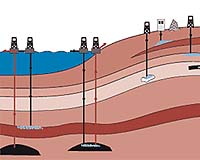
Carbon storage entails taking carbon dioxide (CO2), the principal greenhouse gas, at source from power stations and other big polluters.
Instead of letting the CO2 be disgorged into the air, it would be pumped into deep chambers underground and stored.
Several pilot schemes are already underway to test the feasibility of this idea, which is enthusiastically backed by many actors in the coal industry.
Many scientists are worried, though, about the long-term safety of storage.
If a geological chamber proves to be flawed or is one day ruptured by an earthquake, that could send the sequestrated CO2 into the atmosphere, fuelling global warming for generations to come.
The press statement did not say how much money would be put into the five projects or where they would be implemented.
The schemes come under the aegis of the US-Australian Climate Action Partnership (CAP), launched in 2002 to promote the search for technological fixes to the greenhouse-gas problem.
"Both parties are pleased with the progress of the CAP in achieving practical results on climate change through the more than 27 current and completed projects previously agreed," the State Department said.
The United States and Australia are the only industrialised countries to refuse to ratify the UN's Kyoto Protocol on curbing greenhouse gases, a stance that has earned them the wrath of many environmentalists.
The US says the treaty is too costly for its economy, and both Washington and Canberra argue that the accord is ineffective so long as it fails to include big developing countries, and not just industrialised countries, in binding promises to curb their pollution.
