
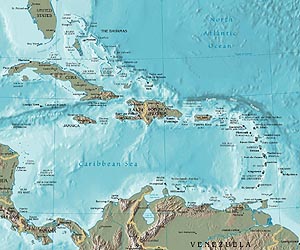
The first tsunami exercise for the Caribbean gets underway Wednesday with the participation of 33 countries, testing the region's emergency preparedness after Japan's recent devastation, officials said.
Called "Caribbean Wave 11," the exercise does not directly involve communities but will test the warning systems and responses of emergency management agencies from around the region.
It will also examine how quickly and efficiently information is transmitted, and review evacuation plans and public information campaigns to manage the risk to schools.
The exercise was to begin Wednesday when the countries of the Caribbean receive a tsunami alert resulting from a fictitious 7.6 magnitude earthquake off the coast of the US Virgin Islands.
US tsunami warning centers will trigger the exercise by issuing bulletins for Puerto Rico and the Virgin Islands, and for non-US parts of the region.
"The earthquake and tsunami that have devastated Japan have shown how essential alert systems are," said Irina Bokova, UNESCO's director general.
"In this context, the development of a coordinated system in the Caribbean is more relevant than ever, enabling coastal countries to prepare in the event of such a disaster and to save human lives," she said.
The authorities are seeking to test the functioning of a warning system for the Caribbean set up in 2005 in collaboration with UNESCO's Intergovernmental Oceanographic Committee.
Over the past 500 years, there have been 75 tsunamis in the Caribbean, which is about 10 percent of the world total during that period, according to the National Oceanographic and Atmospheric Administration (NOAA).
Tsunamis caused by earthquakes, landslides or volcanoes have caused 3,5000 deaths in the region since the mid-1800s, NOAA said.
Share This Article With Planet Earth
