
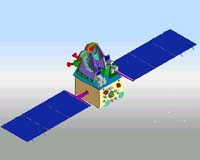
The two panchromatic cameras on board ISRO's latest satellite, CARTOSAT-1, have been tested during the last two days by switching them on through a series of programmed commands sent from Spacecraft Control Centre of ISRO Telemetry, Tracking and Command Network (ISTRAC) at Bangalore.
Imageries from both the cameras were received at National Remote Sensing Agency's Data Reception Station at Shadnagar, near Hyderabad.
Detailed analysis confirms the excellent performance of the cameras. Imageries have been received from the satellite over Punjab and Gujarat on May 8, 2005. The imageries also include one over Amritsar.
It may be recalled that the 1560 kg CARTOSAT-1 was successfully launched during the ninth flight of ISRO's Polar Satellite Launch Vehicle, PSLV-C6, from Satish Dhawan Space Centre (SDSC) SHAR, Sriharikota, on May 05, 2005.
CARTOSAT-1 carries two panchromatic cameras that take black-and-white stereoscopic pictures in the visible region of the electromagnetic spectrum. The imageries have a spatial resolution of 2.5 metre and cover a swath of 30 km.
As soon as CARTOSAT-1 was injected into orbit, the two solar panels were automatically deployed to generate the required electrical power.
Subsequently, the earth acquisition and three-axis stabilisation of the satellite were carried out and all the subsystems were checked out before commanding the camera operation on May 7, 2005.
Further calibration of data, validation of the ground processing systems for decoding the signals and other initial operations are continuing.
Fine-tuning the orbit to the required 618 km circular with an inclination of 97.89 deg with respect to the equator is also being carried out.
HAMSAT Functioning Well
