
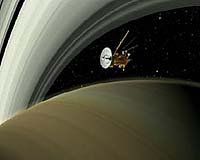
NASA's Cassini spacecraft successfully performed a getaway maneuver on Monday, Dec. 27, to keep it from following the European Space Agency's Huygens probe into the atmosphere of Saturn's moon Titan.
This maneuver established the required geometry between the probe and the orbiter for radio communications during the probe descent on Jan. 14. The probe has no navigating capability, so the Cassini orbiter had been placed on a deliberate collision course with Titan to ensure the accurate delivery of the probe to Titan.
The Huygens probe successfully detached from the Cassini orbiter on Dec. 24. All systems performed as expected.
The European Space Agency's Huygens probe will be the first human- made object to explore on-site the unique environment of Titan, whose chemistry is thought to be very similar to that of early Earth before life arose.
Next up for Cassini was a flyby of Saturn's icy moon Iapetus on Dec. 31. Iapetus is Saturn's two-faced moon — one side is very bright, and the other is very dark. One scenario for this striking difference is that the moon's surface is being resurfaced by some material spewing from within.
Pocked Moon
