
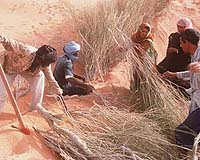
Five former Soviet republics have launched a 1.4 billion-dollar program funded by development lenders and aid agencies to halt and reverse the spread of deserts in Central Asia, the Asian Development Bank said Friday. Over the next 10 years Philippines-based ADB will coordinate overall activities of the Central Asian Countries Initiative for Land Management involving Kazakhstan, Kyrgyzstan, Tajikistan, Turkmenistan, and Uzbekistan, a bank statement said.
Land degradation from overgrazing, soil erosion, salt damage to irrigated land, and desertification is a serious problem in these countries, directly affecting the livelihood of nearly 20 million rural inhabitants, it added.
Farm yields are reported to have plunged 20 to 30 percent across the Central Asian region since the five countries achieved independence more than a decade ago, it said.
Data showed that about 70 percent of the total area of Turkmenistan has become desert, while salinized irrigated areas account for 50 percent in Uzbekistan and 37 percent in Turkmenistan.
"This project brings together a unique blend of partners involving countries and donor agencies to tackle land degradation, one of the most critical environmental problems in Central Asia," said Monique Barbut, chief executive of the Global Environment Facility, a United Nations fund which is providing 20 million dollars in grant financing.
ADB said about 155 million dollars in funds had been committed to the project up to end-2008.
The project includes management of biodiversity conservation, pasturelands, sustainable agriculture on irrigated land, and forest and woodlands; and capacity building in land use planning.
The other project partners are the Canadian International Development Agency, the German Agency for Technical Cooperation, UN Food and Agriculture Organization, Global Mechanism, International Center for Agricultural Development and International Fund for Agricultural Development.
The Swiss Agency for Development Cooperation, UN Development Programme, UN Environment Programme, and the World Bank are also among the partners.
