
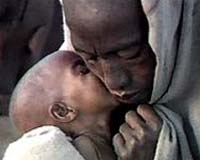
The child malnutrition rate in drought-hit areas of eastern Ethiopia has surpassed 20 percent and two out of every 10,000 children are dying each day, according to a study released Tuesday.
The report, the first nutritional study completed in Ethiopia's worst-hit Somali region since the effects of the drought have taken hold across east Africa, found more than one in five children to be severely malnourished.
"The prevalence of global acute malnutrition among the surveyed population was estimated at 20.1 percent which can be considered 'critical'," said the study by the US and British aid agency Save the Children.
Out of every 10,000 children under five, 2.4 are dying daily and 32.8 percent of them, nearly one in three, are ill, mainly with life-threatening diarrhea and at risk of contracting measles and other diseases, it said.
"The under five mortality rate and the prevalence of illness indicate the presence of high risk of child illness and mortality among the population in the surveyed areas," the report said.
The survey of more than 900 children in two areas of Somali state followed a dire warning from the UN Children's Fund (UNICEF) that 1.5 million youngsters are at risk in countries across east Africa, including Ethiopia.
It said about eight million people in total are threatened with drought-related malnutrition and potential famine in four nations — Djibouti, Ethiopia, Kenya and Somalia. Of those 1.75 million are in Ethiopia.
"There is a potential for widespread disease, greater malnutrition and the displacement of significant numbers of people," UNICEF chief Ann Veneman said in a statement released in Geneva.
In Addis Ababa, UNICEF's Ethiopia country director Bjorn Ljunqvist said the figures for Somali state were "alarming" and urged that assistance to drought-stricken areas be boosted immediately.
"These rates are alarming," he told AFP. "When you have general malnutrition rates over 15 percent it is alarming. These rates call for immediate action to be taken."
As in the other three nations, livestock-dependent nomadic pastoralists have been hardest hit with mass deaths of cattle, goats, sheep and camels, Save the Children said.
"As a result, households' income source decreased and as a result children are becoming malnourished," the report said.
Source: Agence France-Presse
related report
Somali Parliament Speaker Appeals For Aid In 'City Of Death'
Baidoa, Somalia (AFP) Feb 07 – The speaker of Somalia's parliament on Tuesday appealed for international help for millions of Somalis threatened with starvation as he visited this drought-hit central town.
In Baidoa to assess conditions for the first meeting of the Somali legislature in its own country here later this month, Sharif Hassan Sheikh Adan said the world could not ignore the suffering of the Somali people.
"I am urging the international community to help the people of Somalia at this critical time," he said in the town dubbed the "city of death" after thousands perished in the last drought-related famine in 1991-1992.
"I have never seen Baidoa as dry as it is now since my childhood," Adan said. "This is a serious disaster."
Some two million people in central and southern Somalia are among about eight million in four countries across east Africa that are at risk of starvation because of the drought, according to the United Nations.
While UN and international aid agencies are supplying relief, their efforts are vastly complicated by insecurity in anarchic Somalia, which has been without a functioning central government for nearly 15 years.
Deep divisions in the country's current transitional government have exacerbated the problem and Adan's visit to Baidoa, about 250 kilometres (150 miles) west of Mogadishu, is part of an effort to patch up the rifts.
The split between the two factions — one led by President Abdullahi Yusuf Ahmed and the other by Adan and warlords who control Mogadishu — have prevented the parliament from meeting and fuelled fears of even greater unrest.
Under heavy international pressure, the two sides agreed on January 30 that parliament would convene in Baidoa on February 26 for the first time since the government left exile in Kenya last year.
"It is a great history that Baidoa will be hosting the Somalia parliament after a decade-long civil war," Adan told thousands of town residents who turned out to greet him.
"We have ended our hostilities and we will be working together for the pacification of Somalia," he said.
