
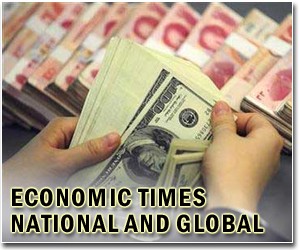
China's consumer prices are expected to rise around four percent next year, a government researcher said Tuesday, warning economic uncertainties abroad could hinder Beijing's efforts to curb inflation.
Inflation in 2011 will be driven by rising wages, higher commodities prices and a flood of liquidity into the economy, Yu Bin, a senior researcher with the Development Research Centre of the State Council, or cabinet, told reporters.
"We expect next year CPI growth will rise to around four percent," Yu said.
"We will face certain inflationary pressures next year, but severe inflation is rather unlikely."
China's consumer price index — a key gauge of inflation — rose 5.1 percent year-on-year in November, the fastest increase in more than two years and well above Beijing's full-year target of three percent, as food costs continued to soar.
Ever fearful of inflation's historical potential to spark unrest, authorities have ordered a range of steps to boost supplies of key goods after severe summer flooding and recent cold snaps hit yields and drove up prices.
As part of these efforts, the central bank announced in October the country's first interest rate hike in nearly three years.
On Friday, the central bank ordered lenders for the sixth time this year to keep more money in reserve as authorities struggle to stem the flow of liquidity into the economy, which is fanning the inflation problem.
However, Yu warned that uncertainties remained over the ability of the government's policies to contain price rises due to "very complicated" international factors that were beyond Beijing's control.
"It is very hard to offset the imported inflation of international commodity price rises induced by dollar depreciation, no matter what measures we take," he told reporters.
"China cannot contain inflation completely at a very low level by depending on its own policies" because the world economy is highly globalised, he said.
Yu predicted economic growth would slow down to around nine percent next year, after hitting 10.3 percent this year.
"The number of jobs to be created by the nine-percent growth will be sufficient to resolve the unemployment pressure problem," he said.
earlier related report
China 2011 lending quota may stay at 2010 level: report
Shanghai (AFP) Dec 14, 2010 –
China is likely to keep its 2011 lending quota at around 7.5 trillion yuan (1.1 trillion dollars), unchanged from this year's target, state media reported Tuesday.
Beijing said this month it would move from a "relatively loose" policy to a "prudent" one as consumer price growth accelerated to 5.1 percent in November, its fastest in more than two years.
Reining in lending had been seen as one tool at Beijing's disposal for curbing inflationary pressures.
But the China Securities Journal, citing unnamed sources, reported that supporting economic growth remains the primary aim for next year's monetary policy.
"China's economy is very large and the credit growth of 7.5 trillion yuan will not trigger all-round inflation", the sources told the newspaper, adding inflation was expected to peak in the second quarter of 2011.
"Policies in the coming three to six months will be curbing inflation, but the inflation pressure will not be as big as expected," the sources were quoted as saying.
The 2011 lending target for the world's second-largest economy has yet to be finalised, the report said.
China's leaders have pledged to ensure "stable and healthy" economic development in 2011, according to an statement released after the annual Central Economic Work Conference, which drafts strategies for the coming year.
The growth in M2, the broadest measure of money supply, will be lowered to 16 percent, down from 17 percent this year, the report said.
China extended 7.44 trillion yuan of new loans in the January-November period, using up 99.3 percent of this year's new yuan loan quota of 7.5 trillion, according to official data.
Yu Bin, a senior researcher with the Development Research Centre of the State Council, or cabinet, said Tuesday that new yuan lending for this year is estimated to be 7.6 trillion yuan, above the official target.
Share This Article With Planet Earth
