
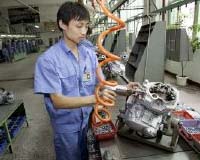
China's manufacturing activity contracted in December, HSBC's closely watched purchasing managers' index (PMI) showed Wednesday, as the world's second-largest economy is buffeted by domestic headwinds.
The British banking giant's final PMI for the month came in at 49.6, HSBC said in a statement, slightly up from a preliminary reading of 49.5 but still the lowest in seven months.
It also marked the first contraction since May's 49.4. Readings above 50 indicate growth, while anything below points to shrinkage.
The index, compiled by information services provider Markit, tracks activity in China's factories and workshops and is a key indicator of the health of the Asian economic giant, a key driver of global growth.
"Today's data confirmed the further slowdown in the manufacturing sector towards year end," Qu Hongbin, HSBC's economist in Hong Kong, said in the statement.
The slowdown was mainly driven by sluggish domestic demand as new orders contracted for the first time since April 2014, he added.
In contrast, new exports rose for the eighth month in a row and at a slightly quicker rate than in November, according to the statement, signalling buoyant foreign demand as US growth recovers.
China's economy faces multiple challenges including falling property prices, high debt levels, and what some economists see a looming threat of deflation.
It expanded 7.3 percent in the third quarter, the government said in October, lower than the 7.5 percent of the previous three months and the slowest since 2009 at the height of the global financial crisis.
It has showed continued weakness in the current fourth quarter.
The central People's Bank of China last month cut interest rates for the first time in more than two years to jolt slowing growth, but analysts say further easing steps are needed.
"We believe that weaker economic activity and stronger disinflationary pressures warrant further monetary easing in the coming months," Qu said.
Chinese leaders have committed themselves to rebalancing the economy to one in which the country's increasingly prosperous consumers drive growth, even if at a slower rate.
The government set a growth target of around 7.5 percent for this year. It is widely believed policymakers lowered that goal to about 7.0 percent for 2015 at a key economic meeting earlier this month.
China home prices fall faster in December
Beijing (AFP) Dec 31, 2014 –
Falls in China's housing prices accelerated in December, a survey showed Wednesday as oversupply continued to weigh on the market and developers offered discounts to shore up their balance sheets towards the year-end.
The average price of a new home in China's 100 major cities was 10,542 yuan ($1,700) per square metre this month, down 0.44 percent from November, the independent China Index Academy said in a statement.
The decrease was faster than November's 0.38 percent fall and marked the eighth straight month that prices have dropped, according to academy data.
On a year-on-year basis, prices fell 2.69 percent in December, greater than the 1.57 percent recorded last month, the statement said.
"Pressured by their annual sales targets and the need for liquidity generation, property companies continued to take the low-price strategy to promote sales, leading prices in the 100 cities to continue to fall," said the statement.
"Looking into 2015, the national market will still be under high inventory pressures… and downside pressures remain on house prices," it added.
The average price in the top 10 cities also fell for the first time in 26 months to 18,878 yuan per square metre, down 0.61 percent from a year ago, the statement said.
Beijing, Shanghai and the southern boom town of Shenzhen bordering Hong Kong were the only three top 10 cities to see annual price rises, it said, with Shanghai the best performer with a 2.46 percent increase to 32,029 yuan per square metre.
China has previously sought to rein in runaway property prices, a source of discontent among ordinary citizens, by introducing market control measures including limits on buying second and third homes.
But local authorities rely on the property sector for a significant proportion of their income, and cities began rolling back some of the measures this year as China's economy slowed and the central government relented.
The central bank in September eased mortgage policies for the real estate sector and last month announced a surprise interest rate cut — the first in more than two years — that analysts said would benefit home buyers the most.
