
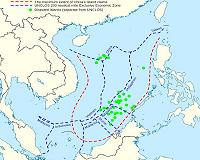
The United States on Saturday expressed concern over reports that China is hampering other countries' oil and gas activities in the South China Sea and accused Beijing of acting like a bully.
The State Department said such acts by China — it did not say when they are alleged to have happened — threaten regional peace and security. It said these acts were interfering in particular with Vietnamese oil and gas exploration and production.
"As Secretary Pompeo noted earlier this year, 'by blocking development in the SCS through coercive means, China prevents ASEAN members from accessing more than $2.5 trillion in recoverable energy reserves,'" spokeswoman Morgan Ortagus said in a statement. ASEAN is the Association of Southeast Asian Nations.
Vietnam and China have long been locked in a maritime disagreement over the resource-rich waters of the South China Sea.
The Chinese claim nearly all of it.
But the international community has largely sided with the other claimants — Vietnam, Philippines, Indonesia, Malaysia, Taiwan and Brunei — citing the importance of freedom of navigation.
"China's reclamation and militarization of disputed outposts in the SCS, along with other efforts to assert its unlawful SCS maritime claims, including the use of maritime militia to intimidate, coerce and threaten other nations, undermine the peace and security of the region," the US statement said.
"The United States firmly opposes coercion and intimidation by any claimant to assert its territorial or maritime claims," Ortagus added.
"China should cease its bullying behavior and refrain from engaging in this type of provocative and destabilizing activity."
Vietnam criticises China over vessels in disputed waters
Hanoi (AFP) July 20, 2019 –
Vietnam has accused China of trespassing and demanded a Chinese survey ship in the South China Sea withdraw in the latest flashpoint over the disputed territory.
The two countries have long been locked in a maritime disagreement over the resource-rich waters, with the Chinese claiming nearly all of it.
But the international community has largely sided with the other claimants — Vietnam, Philippines, Indonesia, Malaysia, Taiwan, and Brunei — citing the importance of freedom of navigation.
On Friday, Vietnam's Ministry of Foreign Affairs criticised China's survey vessel the Haiyang Dizhi 8, and its escort ships, for entering its waters in "recent days," although it did not give exact dates.
"This is completely in the sea area of Vietnam," a statement said, adding they had contacted the Chinese multiple times, on different diplomatic channels, "to protest" the act.
The Vietnamese have "persistently requested them to… withdraw all these ships from Vietnam's waters and respect its sovereignty."
While the Chinese did not confirm the presence of the vessel in the South China Sea, a Ministry of Foreign affairs spokesman said Wednesday that they hope Vietnam "can truly respect China's… jurisdiction" over the waters.
"We hope that the Vietnamese side can… refrain from taking actions that may complicate the situation," said spokesman Geng Shuang.
In June, a Chinese vessel and a fishing boat from the Philippines collided in the South China Sea, sparking public outrage as Manila accused the trawler of abandoning the 22 Filipino crew members.
China defended itself, saying their ship had "bumped" into the vessel and had attempted a rescue — but were "afraid of being besieged by other Filipino fishing boats."
Saudi Arabia has decided to host US troops: Saudi defence ministry
Riyadh (AFP) July 19, 2019 –
Saudi Arabia has decided to host US troops in a joint move with Washington to boost regional security, the kingdom's defence ministry said, as tensions soar in the Gulf.
"Based on mutual cooperation between Saudi Arabia and the United States of America, and their desire to enhance everything that could preserve the security of the region and its stability… King Salman gave his approval to host American forces," a ministry spokesman was quoted by Saudi state news agency SPA as saying.
Saudi Arabia has not hosted US forces since 2003 when they withdrew following the end of the war with Iraq.
The US presence in Saudi Arabia lasted 12 years, starting with Operation Desert Storm in 1991, when Iraq invaded Kuwait.
As many as 200 US aircraft were stationed at the Prince Sultan air base situated around 80 kilometres (50 miles) south of the capital at the peak of the Iraq war, and as many as 2,700 missions a day were handled by the headquarters in Saudi Arabia.
But relations between the two countries were not always easy during the 12 years of cooperation, particularly following the September 11, 2001 attacks in New York which were orchestrated by Saudi-born al-Qaeda leader Osama bin Laden.
Tensions in the Gulf increased further on Friday as Iran said it had confiscated a British-flagged tanker in the Strait of Hormuz and as US President Donald Trump insisted that the US military had downed an Iranian drone that was threatening a US naval vessel, despite denials from Tehran.
