
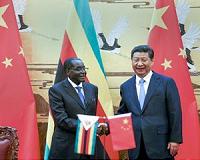
China on Wednesday said it respected Robert Mugabe's decision to step down as president of Zimbabwe and vowed to continue "friendly" relations with the country it backed during his authoritarian rule.
China became a major political and economic partner of Mugabe's regime over the years as the West shunned the veteran leader over his government's human rights violations.
But the Asian power has avoided taking sides since the military took over and placed Mugabe under house arrest last week.
Chinese foreign ministry spokesman Lu Kang praised Mugabe, 93, for his "historic contributions" to Zimbabwe's independence and his commitment to the friendship between the two countries.
"China respects Mr. Mugabe's decision to resign, and he is still a good friend of the Chinese people," Lu Kang told a regular news briefing.
The spokesman also said China was ready to work with those in power in Zimbabwe.
"Our friendly policy towards Zimbabwe will not change. We want to continue to follow the principles of equality, mutual benefits, and win-win cooperation," Lu said.
Mugabe resigned on Tuesday, swept from power as his 37 years of authoritarian rule crumbled within days of a military takeover.
Zimbabwe, meanwhile, awaited to see who would replace him.
Former vice president Emmerson Mnangagwa, whose sacking earlier this month led to Mugabe's downfall, was expected to return home on Wednesday, his aide said.
Mugabe adopted a "look east" policy and Chinese President Xi Jinping was one of the rare foreign heads of state to visit Harare when he made a stop there in 2015.
When Mugabe visited Beijing in 2014, Xi lionised him as an "old friend" of the Chinese people.
Mnangagwa also has historical ties with China, having undergone military training in the Asian country before joining Zimbabwe's struggle for independence from Britain.
And Army chief General Constantino Chiwenga, a key figure in forcing Mugabe out, happened to be on an official visit in China when Mnangagwa was ousted by Mugabe.
"China respects the choice made by Zimbabwe's people and we consistently and strongly adhere to the principle of not interfering in other countries' domestic affairs," Lu said.
Zimbabwe's relations with China and the Chinese Communist Party date back to the liberation struggle of the 1970s, when Beijing provided arms and trained some of the top guerrilla leaders.
China has invested heavily across Africa and Zimbabwe has benefited from its ties with Beijing.
Zimbabwe was China's largest foreign supplier of tobacco, with some 40 percent of the tobacco imported by the Asian country coming from the African nation.
China set up a joint venture with Zimbabwe in a diamond mining company, but Mugabe announced the nationalisation of the nation's diamond mines last year. The Asian country imported $2.5 million worth of diamonds from Zimbabwe last year.
Chinese companies have also been involved in projects to install a cellular phone network, expand a hydropower station and build a coal-fired power plant.
Zimbabwe's next leader heads home after Mugabe exit
Harare (AFP) Nov 22, 2017 –
Zimbabwe's former vice president Emmerson Mnangagwa was to return home on Wednesday to take power after Robert Mugabe's resignation brought a sudden end to 37 years of authoritarian rule.
Ahead of his arrival, parliament speaker Jacob Mudenda confirmed he would be sworn in as president at an inauguration ceremony on Friday.
Mugabe's iron grip ended in a shock announcement to parliament where MPs had convened to impeach the 93-year-old who dominated every aspect of Zimbabwean public life for decades.
On the streets, the news that his long and often brutal leadership was over sparked wild celebrations which lasted late into the night, with crowds dancing and cheering ecstatically amid a cacophony of car horns.
Mnangagwa, 75, was sacked by the president on November 6 in a move that pushed infuriated army chiefs to intervene, triggering a series of events which led to Mugabe's ouster.
A former key Mugabe ally, Mnangagwa fled the country after his dismissal, saying he would not return without guarantees of his safety.
His sacking was the result of an increasingly bitter succession battle with Mugabe's wife Grace, who had been pushing to take over from the ageing leader.
"My decision to resign is voluntary," Mugabe wrote in his resignation letter, expressing his "desire to ensure a smooth, peaceful and non-violent transfer of power".
– Party hardliner –
In a highly symbolic scene shortly after his resignation, a man took down a portrait of Mugabe from a wall inside the building where MPs had assembled for the extraordinary session to impeach the defiant president.
Another person replaced it with an image of the ousted vice president.
Mnangagwa is a long-time party loyalist who has close ties with the military. Critics describe him as a ruthless hardliner responsible for years of state-sponsored violence.
Senior military commanders, official cars and a crowd of journalists were waiting at Harare's Manyame airbase aerodrome where Mnangagwa is expected to land, said AFP correspondents at the scene.
Mugabe's resignation capped a week in which the military seized control and tens of thousands of Zimbabweans took to the streets in an unprecedented show of dissent against Mugabe.
– Outstayed his welcome –
"We want our new president to make sure power hungry gangs don't infiltrate," said Talent Chamunorwa, 37, a brick seller.
"We hope to be able to access our money from the bank come December and the US dollar must come back."
He was referring to Zimbabwe's chronic shortage of cash and a mistrusted "bond note" scheme intended to be pegged to the greenback but trading at a lower rate in reality.
As the news began to sink in, crowds gathered brandishing national flags with many among them praising army chief General Constantino Chiwenga who led the military power-grab.
Mugabe had ruled Zimbabwe almost unopposed since independence in 1980 — but his efforts to position his 52-year-old wife Grace as his successor were his undoing.
But his monolithic grip was shattered last week when armoured military vehicles took to the streets, blockaded parliament and soldiers placed him under house arrest.
The fate of Mugabe, who was the world's oldest serving head of state, and that of his wife, remain unknown, but ZANU-PF has said he deserved to be treated with respect after leading the country for nearly four decades.
"He deserves to rest and I believe every Zimbabwean agrees with this," said Moyo.
"But I think he had overstayed the hospitality of the people of Zimbabwe."
– A new path –
Last week's military takeover had all the hallmarks of a coup, but the generals stopped short of forcing Mugabe out.
As the crisis grew, the ZANU-PF party, an instrument of Mugabe's brutal reign, removed him as party leader and began parliamentary proceedings to have him impeached.
"When he saw the turnout (of lawmakers), he probably realised he'd better jump before he was pushed," said Derek Matyszak, an analyst at the Pretoria-based Institute for Security Studies.
Mugabe's resignation was hailed by the international community as a chance to reshape Zimbabwe's future, with British Prime Minister Theresa May saying it offered "an opportunity to forge a new path free of the oppression" that characterised Mugabe's rule.
US Secretary of State Rex Tillerson said it offered Zimbabwe "an extraordinary opportunity to set itself on a new path".
And Beijing, which became a major political and economic partner of Harare as it was shunned by the west, said it respected his decision, describing Mugabe as a "good friend of the Chinese people".
Most Zimbabweans have only known life under Mugabe, whose time in power was defined by violent suppression, economic collapse and international isolation.
Zimbabwe is locked in one of its worst political crises since independence with strongman Robert Mugabe refusing to resign despite a military takeover, mass street protests and possible impeachment.
Here is a snapshot of the ongoing turmoil:
– Vice president sacked –
November 6: Mugabe fires Vice President Emmerson Mnangagwa to resolve a succession dispute.
His removal appears … read more
