
China plans to take 'eggs' from pedigree pigs on its second manned space mission to study whether exposure to outer space alters the genetic make-up of the 'eggs', state media said Sunday.
Some 40 grams of pig 'eggs' will be carried on board the spacecraft Shenzhou VI when it blasts off in early October, the Xinhua news agency said.
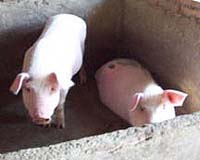
The 'eggs' will come from two carefully selected "Rongchang" pigs, which are named after Rongchang county in southwest China's Chongqing municipality.
The pigs are considered outstanding in terms of their physique and the quality of their pork, Xinhua said.
Some 'eggs' will be kept inside the capsule of the Shenzhou VI and some will be stored outside it, enabling scientists to study the impact of microgravity and cosmic rays on the samples.
After four or five days in space, the 'eggs' will be brought back to earth and used to fertilise pig eggs in test-tubes. The procedure will be conducted by the Chongqing Academy of Animal Husbandry Science.
Two astronauts will circle the earth for five to six days during the space flight – only China's second manned space mission after Shenzhou V's successful launch in late 2003, which lasted 21 hours.
China is only the third country after Russia and the United States to launch its own manned space flights.
