
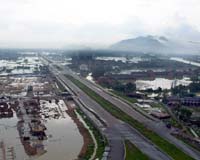
Typhoon Saomai killed at least 134 Chinese and left over 163 missing, state media said Sunday, as reports emerged of fishing villages crushed by the strongest storm to make landfall for half a century. An unknown number of fishermen were at sea when Saomai arrived in southeast China's Fujian province, leaving anxious families with no news of their loved ones.
One local resident described how he walked along the coastline in the north of the province, near the fishing town of Shacheng, trying to identify the body of his wife's uncle.
He said he came across several bodies that had drifted ashore but not the one he was looking for.
"The bodies had become so bloated in the hot weather that they were impossible to recognize," he told AFP by telephone, asking not to be named. "We could only tell people apart from the clothes they were wearing."
The Southern Metropolitan Daily reported from Shacheng on Sunday that many fishing vessels had disappeared, with families desperate to know what happened to their sons, husbands and brothers.
Saomai caused Shacheng to lose a staggering 1,000 fishing boats, while half its 8,000 families were made homeless when the storm flattened their houses.
An official at the Flood Control Headquarters of Fuding city near Shacheng declined comment when contacted by AFP, saying the death toll was still being verified.
Fuding also saw horrific damage, reporting 41 killed, 107 missing and 1,350 people injured as hundreds of houses collapsed, according to Xinhua.
The city's Ziguo Temple, a priceless relic of Buddhist architecture more than 1,000 years old, was also severely damaged, Xinhua said.
Over 20 structures inside the temple compound had collapsed, causing almost "total destruction," the agency said.
Fuding, along with other cities in the disaster area, were visited over the weekend by Vice Premier Hui Liangyu.
"Clean drinking water, clothes, a place to stay, medical service and schooling must be made available to people affected by typhoon," Hui said, according to Xinhua.
In the same area of Fujian province, Saomai had struck with such force that Baisheng village, with some 300 households, had been wiped virtually off the map.
"Almost the whole village was flattened," an unnamed local resident told Xinhua.
Most deaths confirmed so far were from Zhejiang province, one of China's most developed and prosperous provinces immediately to the north of Fujian.
In Wenzhou, a booming port city with more than one million residents and an engine of Zhejiang's economic growth, 81 people were reported killed and 11 missing.
Six people were crushed to death in a landslide triggered by torrential rain in Lishui city. In the province of Jiangxi, further to the west, two people were reported killed.
Saomai generated winds of up to 216 kilometers (135 miles) an hour when it hit Zhejiang, making it the strongest typhoon to strike China since 1956, according to the China Meteorological Administration.
The typhoon was downgraded early Friday to a tropical storm and by early Sunday it was graded again as a tropical depression.
Typhoon Prapiroon, which made landfall on August 3, killed at least 80 people and Tropical Storm Bilis, which hit on July 14, hovered over eastern and central China for 10 days, killing more than 600 people.
For some, China's typhoons are worsened by government actions
For many, China's typhoons are part of a series of natural disasters that devastate this nation every year, but in numerous villages and regions, people say a human element is always involved.
"They (the authorities) refused to open the Shaoguan flood gates so the water backed up and flooded the city," said Cai Shiji, a city resident whose home on the banks of the Beijiang river was inundated with over a meter of water.
"Up in Hunan (province), they opened all their flood gates so the water came rushing down to us.
"They don't care about us. They only wanted to protect Yingde (city) and Guangzhou downstream, so they flooded Shaoguan."
Shaoguan is a picturesque city of about a million people that sits at the juncture of the Wu and Zhan rivers, both tributaries to the Beijiang river, better known as the Pearl River when it reaches Guangzhou, capital of Guangdong province.
Downtown Shaoguan, which sits on a narrow peninsula between the two rivers, was submerged for two days and three nights from July 16, after Typhoon Bilis dumped torrents of rain on the region covering parts of Guangdong and neighboring southern Hunan and Jiangxi provinces.
Nearly 900 people were killed or left missing in the typhoon's wake, with most of the fatalities coming in southern Hunan, not far from Shaoguan.
"I've never seen anything like it," said Hou Laoda, a farmer in Huanglang village just north of Shaoguan, whose village was flattened by the flooding brought on by Bilis.
"This was the worst flooding in over 100 years."
Government officials came to the village on the afternoon of July 15 and told people to begin evacuating. The waters started rising in the morning of the 16th, he said.
"They knew it was coming, but they could have told us earlier. A lot of people didn't have enough time to save their personal belongings," Hou told AFP.
The waters in the village rose nearly three meters (10 feet) with the torrents bursting around a Wu river flood-control gate at the southern end of the village, sweeping away everything in its path.
Anger amongst the residents has resulted in the sacking of Tan Weidong, the top Communist Party official in Shaoguan prefecture, on August 4, the official Southern Daily reported.
"They fired him because he didn't handle the anti-flood preparation work, but the authorities also want to bring in someone new who cannot be blamed by the people," Cai, the Shaoguan resident, said.
"For sure, they will investigate Tan to see if he did anything wrong, but it will be 10 years before they tell us the results of the investigation. That's how it is here in China."
Despite the destruction in the Shaoguan city area, the worst hit region in Guangdong was farther north around Lechang city, where over three meters of water submerged the city, leaving over 150 people dead or missing and cutting the vital rail link between Beijing and Guangdong.
Anger by locals over the government's handling of the floods and its aftermath have reportedly led to mass protests in front of the city government offices, local residents said.
"Everyone in the village escaped with their lives, but we all lost our homes and belongings," said Hou Xiaolan, a young woman in her 20s who lives in Huanglang village.
"The water rose so fast we couldn't get everything out, we were trying to get stuff out but when the water reached waist level, we had to leave the village.
"They could have warned us sooner."
Despite the devastation and destruction, most villagers appeared resigned to start rebuilding their homes and lives, but all were holding out hopes that the government would help out.
"We have been hearing that they will be spending 50 million yuan (6.2 million dollars) on the recovery, but the local authorities are still holding meetings about this," Hou's husband said.
"They might move the village to a new place on higher ground because we had floods last year and in 2001. Those were nothing like this year's flood."
