
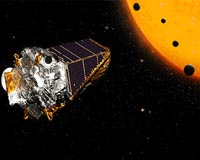
Citizen scientists have discovered an exoplanet twice the size of Earth located 226 light-years from Earth. The exoplanet's signature was discovered among data collected by NASA's Kepler space telescope.
The alien world, named K2-288Bb, is roughly twice the size of Earth, but scientists aren't certain whether it's composed of rock or is a mostly gaseous world, like Neptune. The exoplanet orbits a pair cool stars found within the Taurus constellation, both smaller and dimmer than the sun. The duo are separated by 5.1 billion miles.
"It's a very exciting discovery due to how it was found, its temperate orbit and because planets of this size seem to be relatively uncommon," Adina Feinstein, a University of Chicago graduate student who aided the discovery of K2-288Bb, said in a news release.
Kepler ran out of fuel last year, but algorithms, scientists and citizen scientists continue to scan its massive dataset for dimming patterns created by exoplanet transits.
Scientists found two transit signatures among data collected during the fourth observing campaign of Kepler's K2 mission, but they were unable to locate a third. Three transits are needed to confirm an exoplanet candidate.
But researchers hadn't seen all the data. During Kepler's K2 phase, the spacecraft's reorienting process introduced data anomalies that forced researchers to ignore the first few days of observations during each new campaign.
Only later did NASA scientists develop techniques to adjust for the anomalies.
"We eventually re-ran all data from the early campaigns through the modified software and then re-ran the planet search to get a list of candidates, but these candidates were never fully visually inspected," said Joshua Schlieder, an astrophysicist at NASA's Goddard Space Flight Center. "Inspecting, or vetting, transits with the human eye is crucial because noise and other astrophysical events can mimic transits."
Never examined by scientists, the re-processed data was relinquished to the citizen science project Exoplanet Explorers. Participating amateur astronomers located the third transit scientists were looking for, confirming the presence of K2-288Bb.
"It took the keen eyes of citizen scientists to make this extremely valuable find and point us to it," Feinstein said.
Scientists described the newly discovered exoplanet this week in the Astronomical Journal.
