
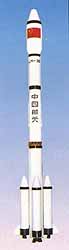
Washington DC – October 21, 1997 – The Clinton administration is poised to ease current U.S. restrictions on launches of American-made satellites and commercial spacecraft aboard Chinese Long March launch vehicles, Washington sources tell SpaceCast in an exclusive report. The decision will be made part of a package of trade and technological exchanges between the U.S. and Communist China and announced by President Clinton during next week's state visit of Chinese President Jiang Zemin to Washington.
The decision, reached weeks ago and approved by both the State and Defense
Departments, will ease Chinese commercial sales of their Long March 3A, B,
C, and 2E launchers, which are capable of lifting both communications
satellites to geostationary orbit and other commercial space platforms to
low orbits from launch sites in China. The restrictions that remain in
place will still require China to abide by the so-called "Rules of the
Road" agreements that control what prices non-capitalist countries can
charge customers for launch services. An earlier agreement between
Washington and Beijing on commercial space launches had expired, although
Vice President Gore and the U.S. Trade Representative's office had
continued discussions, most recently last spring with the visitation of a
Chinese negotiating team to DC. The restrictions maintained a fixed number
of Chinese rockets that could be used to launch American-made satellites.
Since the U.S. makes most of the communications satellites flown, the
restrictions were viewed by China as significant barriers to trade.
Others, however, have pointed to Chinese launch vehicle sales as means by
which China could get more technology from the satellites that fly as
payloads aboard their rockets. Some have suggested that China has "reversed
engineered" some spacecraft packaged for launch from the Xichang Space
Center, thereby learning more about satellite manufacturing and advanced
technology. China has called such claims absurd, and unnecessary for the
nation to advance in the technology needed for space systems.
