
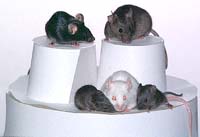
Cloned animals may be harder to clone again, say researchers who have struggled to produce six generations of cloned mice. The result hints at a hidden defect in animals produced by the technology.
Teruhiko Wakayama of the Rockefeller University in New York and his team say the mice in their experiment appeared healthy. But it became harder to clone them with each successive generation.
Only one mouse was produced in the sixth generation despite massive effort. And this lone clone was eaten by its foster mother. "Either it was sick and died or the foster mother didn't like it and destroyed it," he says.
Nuclear transfer
Cloning is based on a technique known as nuclear transfer. The nucleus of a donor cell is fused with an egg stripped of its own genetic material. The result is an animal that is genetically identical to the animal from which the donated nucleus came.
Wakayama and his team first hit the headlines two years ago when they cloned the mouse Cumulina, the first clone produced from an adult animal since Dolly the sheep.
They also announced the remarkable feat of serial cloning. By using donor cells from each successive generation, they produced four generations of clones. In their new report, they report for the first time that they could not produce mice past the sixth generation.
Hidden flaw
