
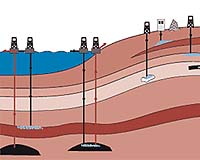
CO2 storage in the ground is being considered increasingly more often in order to realise the climate and energy objectives. Dutch researcher Saikat Mazumder made it possible to better predict routes of the 'underground highways' along which gasses like carbon dioxide (CO2) and methane (CH4) will move. Moreover, coal was found to be highly suitable for filtering carbon dioxide out of waste gasses and storing it.
The 'Enhanced Coalbed Methane process' kills two birds with one stone: carbon dioxide (CO2) is stored in coal seams in the ground and at the same time methane (CH4) is obtained from the process. To optimise this process it is important to know how coal retains and stores some fluids and gasses whilst allowing others through.
The network of cracks is essential for this. Mazumder developed a measuring technique using CT scans that led to an improved understanding of the patterns of cracks. He also did experiments with waste gas and pure CO2 to determine the uptake capacity of single and multi-component gasses. In both wet and dry experiments, CO2 was strongly absorbed and CH4 was released.
This methane production in a coal seam can vary over the course of time. Mazumder developed two estimating methods to gain a better understanding of this. When used together these could generate good predictions.
Problems due to swelling
