
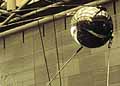
October 4, 1997 – It happened over a week-end 40 years ago this Saturday. Rising from a secret Soviet military base in the Ural mountains, a tiny silver sphere- weighing less than 200 pounds -was rocketed into orbit, becoming the world's first artificial satellite.
Sent aloft by the Soviet Union, the satellite, named Sputnik, or "Fellow Traveler" in English translation, opened the doorway to nearly four decades of space competition between the western democracies and the Communist nations of the East, led by the massive military power of the Soviet Union.
The competition, mainly peaceful in nature, led to the evolution of a wide range of technologies that would create new capabilities in human spaceflight, communications, military reconnaissance, and weather prediction. The highlights of the era that began on Oct. 4, 1957 would see humans voyage into earth's orbit for weeks, walk outside spaceships, and eventually, in the age's climatic moment, trod the ancient dust of the lunar surface.
But today, the legacy of the first Space Age that began with Sputnik may
well be not military competition but a newer kind of race: for commercial
profits, economic strength, and jobs. With the collapse of the Soviet Union
a half decade ago, the focus of space exploration for today's generation of
explorers is commerce: who will be the first to the launch pad, first to
the remote sensing camera in orbit, first to the transponder for
telecommunications needs for nations and businesses, first to exploit space
itself. A kind of race that few could have imagined 40 years ago at the
height of the U.S.-USSR Cold War.
Sputnik's launch shocked the western peoples as had few events since the
end of World War II. But today, thanks to a wide range of research by
scholars around the world, we know that while the public was stunned, the
government of President Dwight D. Eisenhower secretly welcomed the
satellite launch. And others had been trying to tell western leaders the
launch was in the planning months before it happened.
The University of Chicago's John Simpson, speaking at a NASA history conference last week in Washington, said that he even tried to tell the CIA preliminary data on the Sputnik launch given him freely by the Russian scientists involved in the satellite's preparations, months before the launch took place- except, Simpson said, that nobody believed him. Researchers and writers such as R. Cargill Hall, Dwayne A. Day, Ken Osgood and David Snead have written that Sputnik allowed the U.S. to begin military reconnaissance from orbit without the fear that the Soviets would react militarily, since their Sputnik flight established the concept of "Open Skies"- overflight of one nation by the space satellite of another.
Others have pointed out that the race for space supremacy started by the Sputnik and the satellites and space missions that followed it allowed Russia and the west to clash in the laboratories, space centers, and industrial plants producing goods and products, not on the battlefield. And while the satellite launch created a hotly contested race for spaceflight achievement, it could have turned out differently had history itself been different. Sergei Khrushchev, the lone surviving son of the Soviet Premiere that approved the Sputnik flight, told that same NASA conference attendees that his father was moving towards cooperation with the west in space, and might well have ended the "race" with a joint U.S.-Russian moon flight, had his father not been ousted from office in October, 1964. So the space "race" itself might be seen as only one outcome of many possibilities, as space technology evolved.
Today, as the 40th anniversary of the Sputnik 1 mission is noted around
the world, Russia and the U.S. are partners in space collaboration. That
link is considered so strong by some policymakers that each nation's human
space program could not now survive without the support of the other. Even
the U.S. Defense Dept. has booked experiment space aboard the MIR space
station.
In business, U.S. firms such as Boeing and Lockheed Martin are fighting
economic struggles to sell Russian rocket boosters to lift commercial space
payloads. Other, smaller firms are engaged in a process to sell Russian
spacecraft, satellites, and launcher technology. Even the booster that
lifted the Sputnik that long ago Friday in 1957 is being offered for
commercial sale in its Soyuz variant. That race seems long ago, indeed.
