
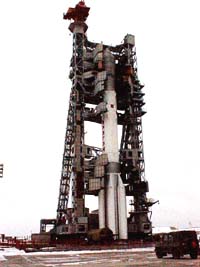
Russia's Khrunichev Space Center has said it has contracts for only two launches of Proton rockets to put commercial satellites in geostationary orbits.
Until recently, Khrunichev had planned three commercial Proton launches next year, but on October 10 the International Launch Service company said launching the satellite Astra K has been postponed from the fourth quarter of 2001 until the first quarter of 2002, a Khrunichev source has told Interfax.
The Center has no other deals to put satellites in geostationary orbits. Experts said the reason is due to the fact that the U.S. State Department has neither given Russia new commercial launch quotas nor abolished any quotas. This, experts said, is upsetting all Khrunichev's commercial plans.
The last declared Proton agreement is a deal on three Teledesic satellite launches with another five Protons being put in a reserve. But the quotas do not apply to those launches because Teledesic satellites will be put in low orbits.
Khrunichev's first setback was the two Proton launch failures in July and October last year. Subsequently, Europe's Ariane rocket took three payloads into space. Khrunichev did at the time receive offers to launch two other, American payloads – a PanAmSat PAS-10 to be launched in the first quarter of 2001, and a GE-6, launched on October 22.
Khrunichev said the quota issue threatens the Center with big losses. Even abolishing all quotas would not help, as it takes 18 months to launch a Proton after a contract is signed. In the future, the ILS proposes to reduce that amount of time to 12 months. So even of the commercial launch quota issue is resolved, it will be a year to 18 months before anything can happen.
It is thought the only way out of this situation is to receive "quick" orders to launch satellites that have already been built and which need to go into orbit fast. But the chances of this happening are equally low, the experts say.
Copyright 2000
