
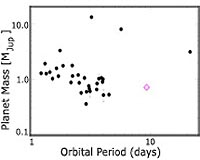
Analysis of data from the CoRoT spacecraft along with complementary ground-based observations reveal CoRoT-Exo-4b to be a gas-giant planet whose parent star appears to rotate in sync with the planet's orbit. This object is also of interest as it occupies a previously empty region of the mass-period parameter space for transiting exoplanets.
This has been reported at the Cool Stars 15 meeting at St Andrews University, Scotland and in two papers, Aigrain et al (2008) and Moutou et al (2008), which have been accepted for publication in Astronomy and Astrophysics Letters.
The parent star, CoRoT-Exo-4, was observed during the initial run of CoRoT which began on 6 February 2007 and continued for 58 days. During this period the spacecraft monitored a 1.3 degrees by 2.6 degrees region of the sky close to the anticentre of the Galaxy (180 degrees away from the Galactic centre).
Lightcurves for all objects observed during this run were processed and analysed for evidence of transits.
Evidence for transits
CoRoT-Exo-4 was one of a number of stars which showed evidence for a transiting body. Analysis of the light curve data allowed Suzanne Aigrain and collaborators to determine a number of parameters for the system including an orbital period of 9.20205 +/- 0.00037 days for the transiting object, designated CoRoT-Exo-4b. This is one of the longest periods measured for any transiting planet to date.
Confirmation of the planetary nature of the object
In an accompanying paper Clare Moutou and collaborators report on a series of complementary ground-based observations which were performed to establish the planetary nature of the transiting body and to provide some basic parameters of the exoplanet and its parent star.
They confirm that the parent star is a Sun-like star (late F-type with a mass of 1.16 solar masses and a radius of 1.17 solar radii). The exoplanet is a gas-giant planet which occupies a previously empty region of the mass-period diagram of transiting planets.
In addition to the periodic dips in the CoRoT-Exo-4 light curve which are associated with planetary transits the light was also seen to vary in a manner typical of a rotating, spotted photosphere. Auto-correlation methods were applied to the light curve to deduce a rotation period for the star of 8.87 +/- 1.12 days.
Planet and Star rotate in sync
Given the similarity between the orbital period of the exoplanet (9.20205 +/- 0.00037 days) and the rotation period of the star (8.87 +/- 1.12 days) it appears as if the star rotates in sync with the planet's orbit. This is unusual especially since the mass and distance from the star seem to preclude any direct effect from the planet on the rotation of the parent star.
Aigrain and collaborators note that the similarity is consistent with a scenario where the planet's migration was halted at the inner edge of a circumstellar disk which was truncated close to the corotation radius. Further detailed analysis is required before any firm conclusions can be drawn on the origin of the synchronised rotation.
