
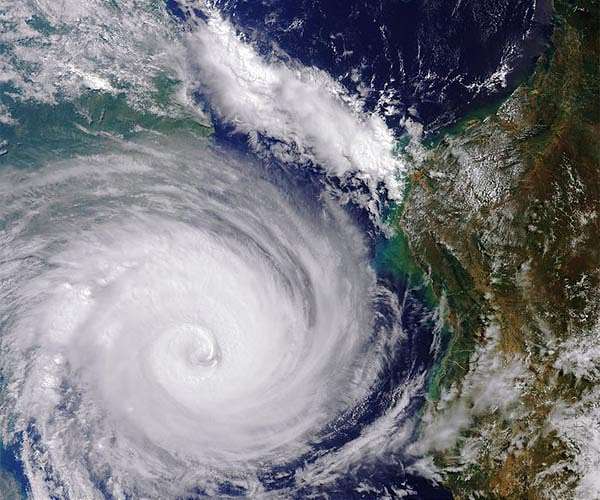
Cyclones have been shifting poleward over the last few decades. Now, new research suggests the tropical storms are also drifting westward across the Pacific and Indian oceans, causing the cyclones to reach their maximum intensity closer to land.
The shift was identified by recent statistical analysis comprising two datasets: tropical cyclone best-track data, as well as what's called reanalysis data, simulations of past global weather conditions.
For their analysis, published Thursday in the journal Science, researchers looked at the paths and intensity of tropical cyclones that churned across the Pacific and Indian oceans between 1982 and 2018.
The data showed that the global shift of cyclones poleward and westward is putting coastal communities at greater risk.
"Generally speaking, tropical cyclones move from east to west, and in major storm basins, the land — and 'money' — is to the west of the storm tracks," lead study author Shuai Wang told UPI in an email.
"That's the main reason we see a closer storm activity to land with westward shift of storm tracks," said Wang, a research associate in atmospheric physics at Imperial College London.
Wang and his colleagues suggest it's too early to determine whether the shift toward land is permanent and driven by climate change, or whether the pattern is being fueled by a temporary shift in atmospheric circulation.
"Natural climate variability [has] the ability to modulate the global large-scale circulation — for example, the Pacific Decadal oscillation," Wang said. "However, it is still an open question at the moment regarding the physical linkage between the past westward track shift and large-scale patterns."
Even if climate change isn't behind the westward shift of tropical cyclones, researchers suggest warming, rising seas could make matters worse for coastal communities.
Unlike surveys that focus on storms that make landfall, the latest study looked at the paths of all storms in the region over the last few decades.
"A 'near-miss' or 'indirect-hit' tropical cyclone track can also cause damage, for example," Wang said. "Sandy in 2012 and Dorian in 2019 skirted along the U.S. coast for a considerable time before making landfall. It is therefore of equal importance to not only focus on the landfall events, but also the coastal storm activities."
The latest research confirmed the reality of a poleward and westward shift among tropical cyclones. In followup studies, researchers said they hope to illuminate the physical mechanism behind the shifts.
