
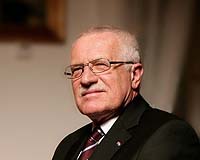
Czech Republic President Vaclav Klaus has challenged the science behind global warming and compared "ambitious environmentalism" to communism in testimony to the U.S Congress released on Wednesday.
Klaus says in a letter to be read before a panel of the U.S. Congress holding hearings on global warming that there are "too many uncertainties in scientific debates on climate change".
He also called arguments attributing climate change to human activities "dangerous" and wrote that "Communism was replaced by the threat of ambitious environmentalism".
"Mankind has already accumulated tragic experience with one very proud intellectual stream that claimed that it knew how to manage society better than spontaneous market forces. It was communism and it failed, leaving behind millions of victims."
Klaus recently visited the United States, and made similar statements on climate change during his stay.
His letter was a response to questions posed to him by the congressional panel. In it he said that a "media-driven hysteria" has harmed discussion on the environment and that there may be benefits to climate change.
"While some deserts may get larger and some ocean shores flooded, enormous parts of the earth — up until now empty because of their severe, cold climate — may become fertile areas able to accommodate millions of people," he said.
He urged leaders to "resist environmentalist calls for new policies" and said it is "impossible to control natural factors causing climate change."
Klaus said the imposition of heavy environmental regulations would keep poorer countries from competing economically.
"Therefore, the moral obligation of the developed countries is not to introduce large emissions reduction schemes," he said.
A United Nations panel said last month that human activity was almost certain to blame for global warming and warned that the Earth's average surface temperature could rise between 1.1 and 6.4 degrees C by 2100.
The panel's findings were in keeping with a growing body of scientific research concerning global warming.
